
AC Died in a Heat Wave? What to Do Right Now
Your AC picked the worst possible moment to quit, which is not a coincidence: extreme heat is when systems work hardest, so it is exactly when marginal ones fail. Right now you do not need theory. You need a sequence. Here it is, in order.
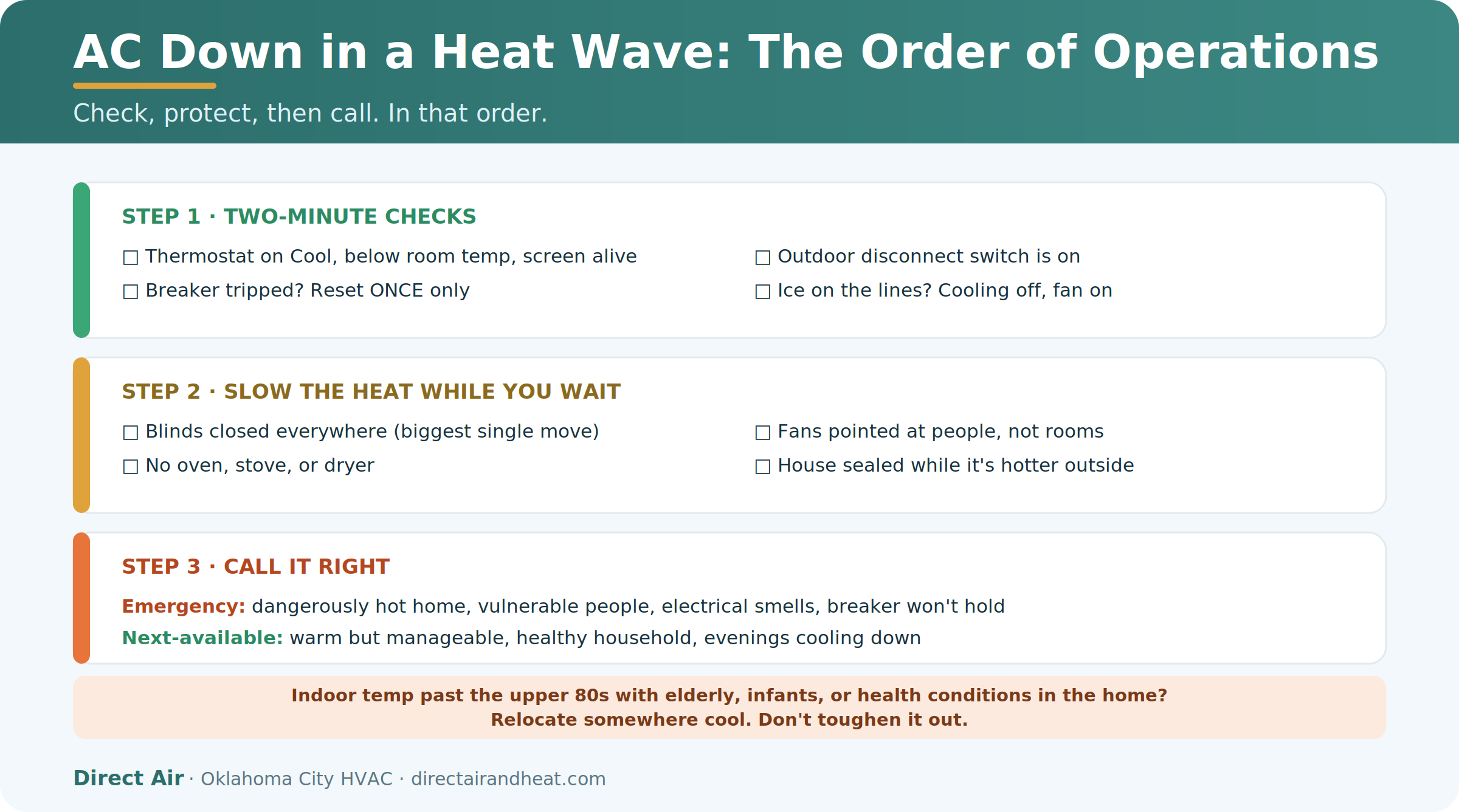
First: the two-minute checks
A surprising share of "dead" ACs are one of these four things. Check them before anything else:
- 1Thermostat. Confirm it is set to Cool, the temperature is below the room reading, and the display is on. If the screen is blank, replace the batteries.
- 2Breaker. Find your electrical panel and look for a tripped breaker labeled AC, HVAC, or condenser. If tripped, reset it once. If it trips again, stop and call. A breaker that keeps tripping is protecting you from an electrical fault, and repeatedly forcing it is dangerous.
- 3The outdoor disconnect. Near the outdoor unit there is a small box with a switch or pull-out. Make sure it was not switched off (lawn crews and kids bump these).
- 4Ice. Look at the copper lines and the indoor unit. If you see ice, switch cooling Off and the fan to On to thaw it, and see our frozen-AC guide for why.
If none of that revives it, the system needs a technician. Move to keeping the house livable while you arrange it.
Keep your home livable while you wait
The goal is to slow the heat gain, because on a 100-degree day an un-cooled house climbs fast:
- Close blinds and curtains everywhere, especially west and south windows. This is the single biggest move.
- Stop making heat inside. No oven, no stove, no dryer. These add real heat to a house that cannot shed it.
- Run ceiling and box fans, and remember fans cool people, not rooms. Point them at occupants.
- Keep doors and windows shut while outdoor air is hotter than indoor air. Open up at night if it cools below inside temperature.
- Hydrate, and move to the lowest floor, since the coolest air settles there.
Know when it's beyond waiting
Heat is not just uncomfortable, it is dangerous. If anyone in the home is elderly, an infant, pregnant, or managing a health condition, and the indoor temperature is climbing past the upper 80s, do not toughen it out. Relocate to a cooler location: a family member's home, a library, a mall, or a designated cooling center. A hot house is replaceable time; heat illness is not worth it.
What counts as an emergency call vs. next-day
Worth being honest about, since emergency service exists for a reason but is not always necessary:
- Call for emergency or same-day repair when the home is dangerously hot, vulnerable people live there, or the failure involves electrical smells, smoke, or a breaker that will not stay on.
- Next-available is fine when the house is warm but manageable, evenings are cooling things down, and everyone in the home is healthy.
Either way, describe the symptoms when you call (what the thermostat shows, what the outdoor unit is doing, any sounds or ice), because it helps the technician arrive with the right parts.
After it's fixed: break the cycle
One more honest note. Mid-July breakdowns are rarely random. They are usually the end of a problem that was visible in the spring: a weak capacitor, a slow leak, a dirty coil. If this is your system's second summer failure, the pattern is telling you something, and the repair-or-replace question deserves a real answer before next season. And a spring tune-up is how most of these calls get prevented entirely.
Direct Air is a family-owned Oklahoma City HVAC company, and summer no-cool calls are what our schedule is built around. If your system is down and the checks above did not revive it, reach us for AC repair in Oklahoma City.
Emergency Service Across the Metro
When cooling fails in the heat, Direct Air responds for homeowners in Moore, Del City, Oklahoma City, and throughout the area: Edmond, Norman, Yukon, Mustang, Midwest City, Choctaw, Nichols Hills, Newcastle, Purcell, El Reno, and Weatherford, OK.
Frequently asked questions
What should I check first when my AC stops working? Four things: the thermostat is on and set to Cool below room temperature, the breaker has not tripped, the outdoor disconnect switch is on, and there is no ice on the lines. These revive a surprising share of "dead" systems.
My AC breaker keeps tripping. Should I keep resetting it? No. Reset it once. If it trips again, it is protecting you from an electrical fault, and repeatedly forcing it is dangerous. That is a call-a-technician situation.
How do I keep my house cool while waiting for repair? Close all blinds, stop using heat-producing appliances like the oven and dryer, run fans pointed at people, keep the house sealed while it is hotter outside, and stay low and hydrated.
When is a broken AC an emergency? When the home is dangerously hot or anyone vulnerable lives there: elderly people, infants, pregnant women, or anyone with health conditions. In those cases seek same-day service and consider relocating somewhere cool in the meantime.
Why did my AC fail during the hottest week of the year? Because extreme heat is when systems work hardest, so existing weaknesses like a failing capacitor, a slow refrigerant leak, or a dirty coil finally give out. Most summer breakdowns are preventable with a spring tune-up.