
AC Fan Setting: Should It Be on "Auto" or "On"?
It's the smallest switch on your thermostat, and one of the most misunderstood. Most people flip it once, never think about it again, and never realize it's quietly shaping how their house feels. In an Oklahoma summer, choosing the wrong one is a common reason a home feels muggy even while the AC is running. For most homes here, the answer is Auto. Here's why, and the specific cases where "On" earns its place.
What each setting actually does
The switch controls the indoor blower fan, the part that pushes air through your vents. It has nothing to do with the outdoor unit or how cold the air gets.
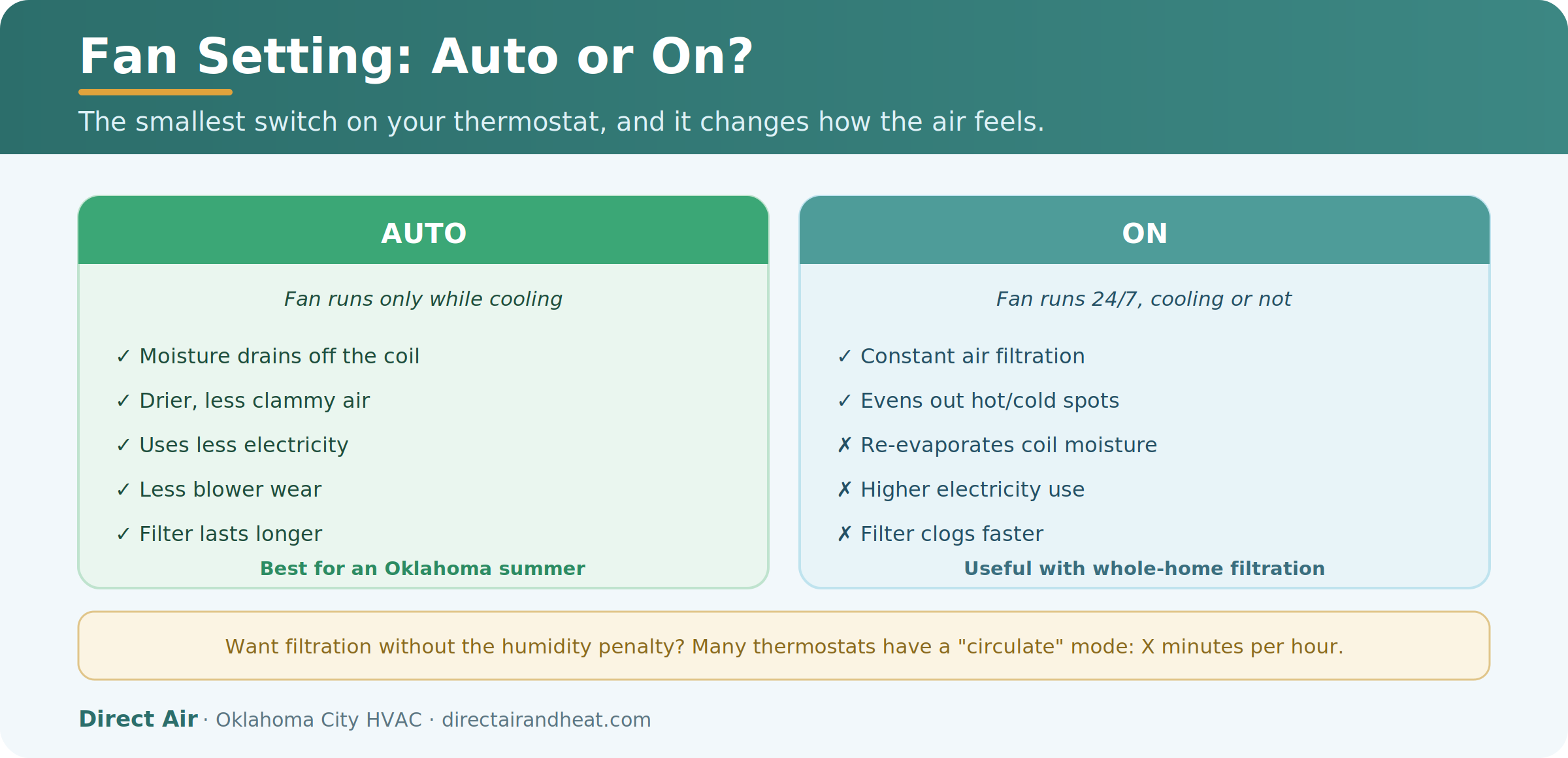
- Auto: the fan runs only when the system is actively heating or cooling. Cool air, then it stops, then it starts again with the next cycle.
- On: the fan runs continuously, 24/7, whether or not the system is cooling. You always have air moving through the vents, but between cooling cycles that air is not being cooled.
That last detail is the whole story.
Why Auto usually wins in Oklahoma
The big one is humidity. When your AC cools, moisture from the air condenses on the cold evaporator coil, then drains away. That's how your system dehumidifies your home.
Now picture "On." The cooling cycle ends, the coil is still wet, and the fan keeps blowing air across it. That air picks the moisture back up and carries it right back into your house before it can drain. In a humid Oklahoma summer, this is a genuinely common cause of the "cool but clammy" feeling. Switching to Auto lets the coil drain properly and keeps that moisture out of your living space.
Auto also uses less energy, since a blower running 24/7 adds up over a long cooling season, and it means less wear on the blower motor and slower filter clogging.
When "On" actually makes sense
It isn't always wrong. Running the fan continuously can help when:
- You're using whole-home filtration or an air purifier and want air passing through it constantly. Better filtration is the strongest argument for "On."
- Your home has stubborn hot and cold spots. Continuous circulation evens temperatures out somewhat, though it treats the symptom rather than the cause (which is usually ductwork or balance).
- Someone in the home has allergies and benefits from constantly filtered air.
- Winter, in a dry house, where re-evaporation isn't a concern and even circulation is welcome.
If you want the filtration benefit without the humidity penalty, many modern thermostats offer a "circulate" mode that runs the fan a set number of minutes per hour. That's the sensible middle ground.
The simple rule
In an Oklahoma summer, set it to Auto. If your home feels sticky and your fan is on "On," flip it and give it a couple of days. It's free, takes two seconds, and for a lot of homes it noticeably improves how the air feels.
If you flip it to Auto and the house still feels humid, the fan wasn't the problem. That points to an oversized system, low refrigerant, or a system that isn't running long enough to dehumidify, and that's worth having looked at.
Direct Air is a family-owned Oklahoma City HVAC company. If your home feels muggy no matter where that switch is set, we'll find out why. Learn more about AC maintenance in Oklahoma City, or call us.
Serving Homeowners Across the OKC Metro
Direct Air keeps homes comfortable in Edmond, Oklahoma City, Norman, and throughout the area: Moore, Yukon, Mustang, Midwest City, Del City, Choctaw, Nichols Hills, Newcastle, Purcell, El Reno, and Weatherford, OK.
Frequently asked questions
Should my AC fan be on Auto or On? For most Oklahoma homes in summer, Auto. It lets moisture drain off the coil instead of being blown back into your house, uses less energy, and reduces wear on the blower.
Does leaving the fan on "On" make my house humid? It can. Between cooling cycles, the fan blows air across a still-wet coil, re-evaporating that moisture into your home instead of letting it drain. That's a common cause of a cool but clammy house.
Does running the fan constantly cost more? Yes. A blower running 24/7 uses noticeably more electricity across a long cooling season than one that runs only during cooling cycles, and it clogs your filter faster.
Is there any benefit to the "On" setting? Yes. It provides constant air filtration (useful with whole-home filtration or for allergies) and helps even out temperature differences between rooms. Many thermostats offer a "circulate" mode as a compromise.
Which fan setting is better in winter? "On" is less problematic in winter, since dry air means there's no coil moisture to re-evaporate, and constant circulation can even out temperatures. Auto still uses less energy.