
Return Vents: The Half of Your AC System Nobody Thinks About
Your air conditioner works in a loop. It pulls air out of your house, cools it, and pushes it back in. Almost everyone pays attention to the second half of that, the vents blowing cold air, and almost nobody thinks about the first half: the vents pulling air back in.
That's a problem, because your system can only push out as much air as it can draw in. Starve the return side and the whole loop suffers, no matter how new or powerful your equipment is. It's also the side homeowners accidentally sabotage, usually with furniture.
Supply vs. return, and how to tell them apart
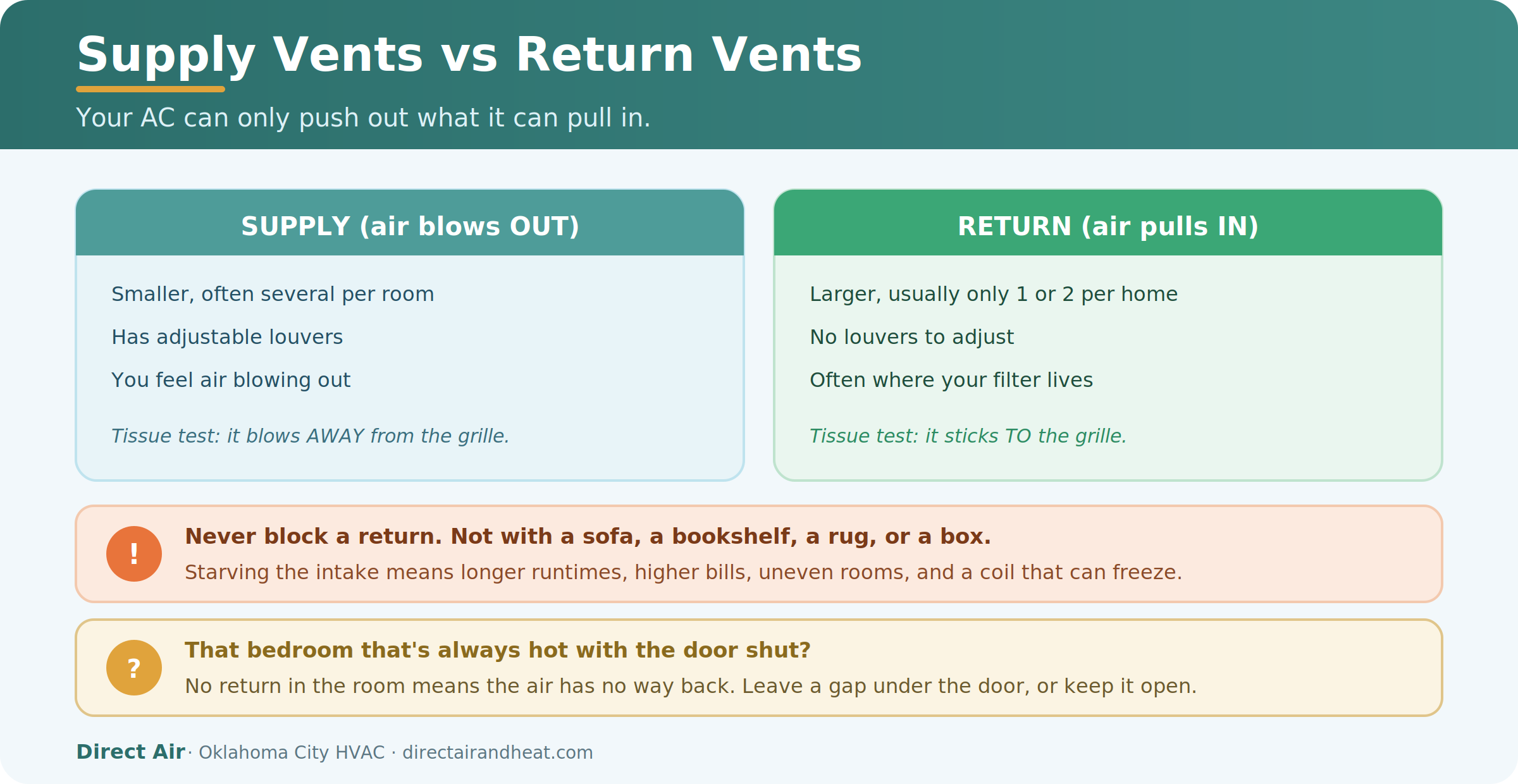
Supply vents deliver conditioned air into the room. They're usually smaller, often have adjustable louvers you can open and close, and you can feel air blowing out of them.
Return vents (or return grilles) pull air back to the system. They're typically larger, usually fixed with no damper to adjust, and if you hold a tissue near one while the system runs, it gets pulled toward the grille instead of blown away. Most homes have just one or two, often in a hallway or a central wall, sometimes near the ceiling.
The tissue test settles it in about three seconds, and most people have genuinely never checked which is which in their own home.
What goes wrong with returns
Because returns look like plain grilles rather than something functional, they get treated as decoration. The common problems:
- Furniture in front of them. A bookshelf, sofa, dresser, or storage bin parked against a return grille chokes the intake. Because it's often in a hallway, this happens without anyone thinking twice about it.
- Rugs over floor returns. Same issue, less visible.
- Closed bedroom doors. This one surprises people. If a bedroom has a supply vent but no return, air pushed into that room needs a path back to the system. Close the door with no gap under it, and the room pressurizes, airflow drops, and it gets warmer while the rest of the house gets cooler. It's one of the most common causes of "that bedroom is always hot."
- A filthy return filter. Many homes have the filter sitting right behind the return grille. If that's you, that grille is your filter location, and it's the most important one to keep clean.
- Not enough return capacity. Some homes were simply built with too little return for the system, especially after an addition or a system upgrade. That's not a homeowner fix, but it's worth knowing it exists as a cause.
Why a starved return costs you
When the return side can't supply enough air, the effects mirror every other airflow problem: longer run times, higher bills, uneven room temperatures, extra strain on the blower, and in a humid Oklahoma summer, a real risk of the evaporator coil freezing over because not enough warm air is moving across it.
The frustrating part is that these symptoms send people looking at the equipment outside, or at the thermostat, when the actual cause might be a couch.
What to do about it, in five minutes
- Walk your house and find your returns. Use the tissue test. Now you know where they are.
- Clear anything blocking them, furniture, boxes, curtains, rugs.
- Don't close them off, ever. Unlike supply vents, returns have no business being shut, and blocking one doesn't redirect air anywhere useful.
- Leave a gap under bedroom doors, or keep doors open where you can. If a room runs hot behind a closed door, this is the first thing to check.
- Check whether your filter lives behind the return grille, and if it does, put that on your monthly check.
When it's worth asking a professional
If your returns are clear, your filter is clean, and rooms still don't balance, the issue may be return capacity or duct design rather than anything you can fix by moving furniture. That's measurable. A technician can check airflow and static pressure and tell you whether the system is fighting a restriction, rather than you guessing at it.
Direct Air is a family-owned Oklahoma City HVAC company. If parts of your home won't balance no matter what you do, we can measure what's actually happening to your airflow instead of guessing. Learn more about AC maintenance in Oklahoma City, or call us.
Serving Homeowners Across the OKC Metro
Direct Air keeps air moving properly for homeowners in Norman, Moore, Oklahoma City, and throughout the area: Edmond, Yukon, Mustang, Midwest City, Del City, Choctaw, Nichols Hills, Newcastle, Purcell, El Reno, and Weatherford, OK.
Frequently asked questions
What is a return vent? A return vent pulls air out of your home and back to the HVAC system to be cooled or heated again. It's usually larger than a supply vent, has no adjustable louvers, and draws air in rather than blowing it out.
How do I tell a supply vent from a return vent? Hold a tissue near it while the system runs. If the tissue blows away, it's a supply vent. If it gets pulled against the grille, it's a return.
Can I block or close a return vent? No. Returns should always stay clear and open. Blocking one starves the system of intake air, which raises run times and energy use and can cause the coil to freeze. Furniture and rugs in front of returns are a common accidental cause.
Why does closing my bedroom door make the room hot? If the room has a supply vent but no return, closing the door traps the air with no path back to the system. The room pressurizes, airflow drops, and it heats up. A gap under the door or leaving it open usually helps.
How many return vents should a house have? It varies by home and system design. Many houses have only one or two central returns. If rooms won't balance even with everything clear, the home may have too little return capacity, which a technician can measure.