
Should You Close Vents in Unused Rooms to Save Money?
It's one of the most common money-saving ideas homeowners try: close the supply vents in the guest room, the spare bedroom, the rooms nobody uses, so you're not "wasting" cool air on empty space. It sounds completely logical. The problem is that in most modern homes, closing vents doesn't save money. It usually costs you more and can even damage your system. Here's why the obvious move backfires, and what actually helps.
Why it seems like it should work
The intuition is that your AC produces a fixed amount of cool air, so if you close off the rooms you don't use, more of that air goes to the rooms you do. Less waste, lower bill. If your system worked like a garden hose, that would be true.
But a central AC isn't a hose. It's a balanced system, sized and set up to push a specific volume of air through your full network of ducts. When you start closing vents, you're not redirecting that air, you're fighting the system.
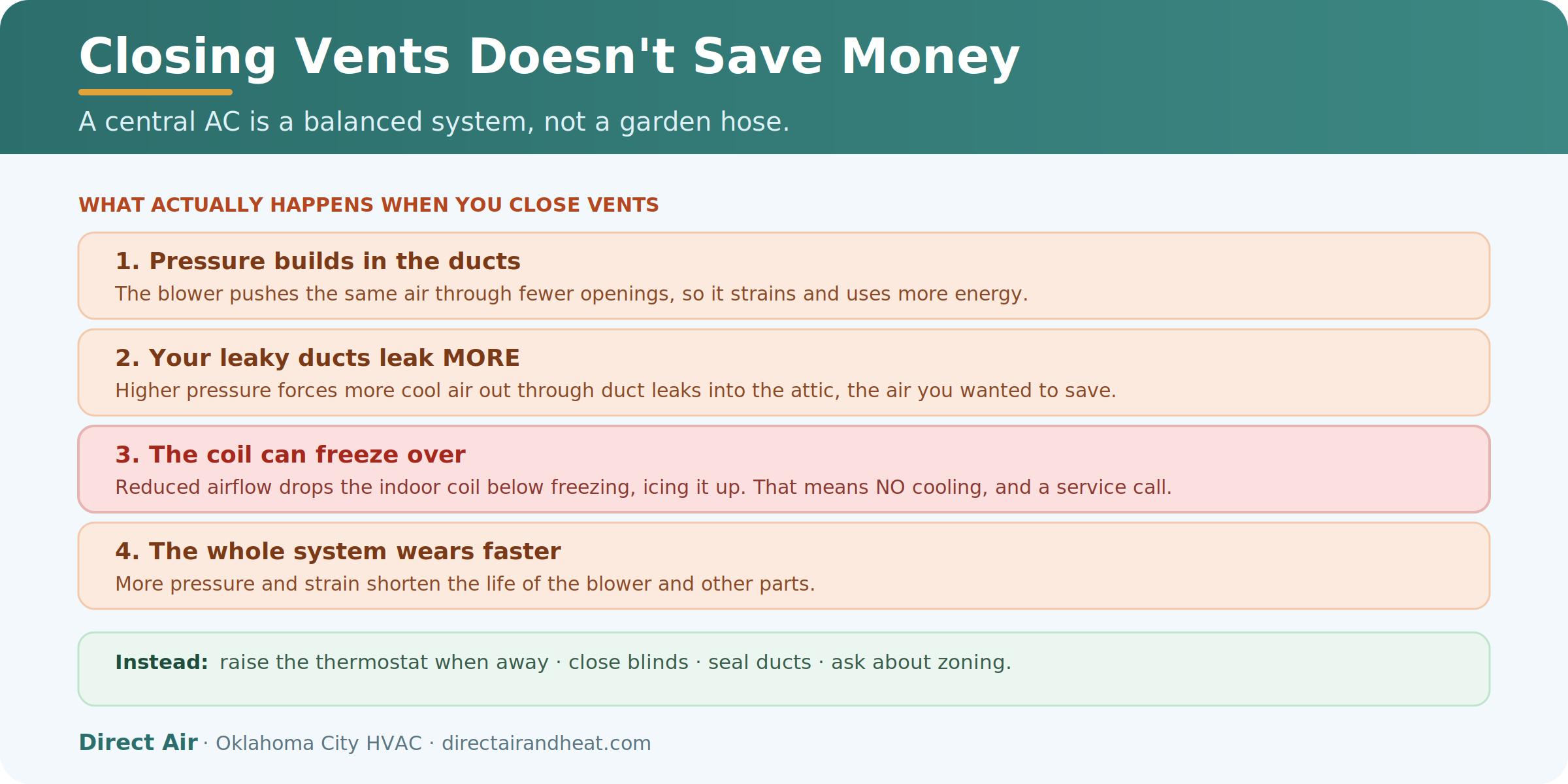
What actually happens when you close vents
Your blower keeps trying to move the same amount of air, but now it has fewer openings to push through. That does a few things, none of them good:
- Pressure builds up in the ductwork. The air has nowhere to go, so static pressure climbs and the blower strains against it, using more energy, not less.
- Your leaky ducts leak more. Most homes have some duct leakage, especially in the attic. Higher pressure forces more of your cool air out through those leaks, into the attic instead of your home. You lose the very air you were trying to save.
- The coil can freeze. Reduced airflow across the indoor evaporator coil can drop it below freezing, icing it over. A frozen coil means no cooling at all, and a possible service call.
- The whole system works harder. Higher pressure and strain shorten the life of the blower and other components.
So the closed-vent "savings" is usually an illusion: the system uses similar or more energy, loses more air to leaks, and takes on extra wear, all to make the rooms you do use slightly less comfortable.
The one exception
Closing a vent or two in a genuinely zoned system (one designed with dampers and multiple thermostats) is fine, because that system is built to handle it. The problem is closing vents in a standard single-zone central system, which is what most homes have. If you're not sure which you have, assume standard and leave the vents open.
And to be clear, cracking one vent slightly in a room that always runs a little cold is not going to hurt anything. The damage comes from closing off several vents to try to force savings.
What to do instead
If you want to spend less cooling rooms you don't use, the real answers are the ones that don't fight your system:
- Raise the thermostat a few degrees, especially when you're away. This is the genuine savings lever.
- Use a smart or programmable thermostat to ease off automatically when nobody's home.
- Close blinds on sunny windows to cut the heat load.
- If certain rooms are truly on a different schedule from the rest of the house, ask about zoning, a system actually designed to condition areas independently, unlike taping vents shut.
- Seal your ducts. If you're worried about wasted air, sealing leaks does far more than closing vents ever could.
Direct Air is a family-owned Oklahoma City HVAC company, and if you've been closing vents to save money and your system seems to be struggling, that may be why. We can check your airflow and point you to changes that actually lower the bill. Learn more about AC maintenance in Oklahoma City, or call us.
Serving Homeowners Across the OKC Metro
Direct Air keeps systems balanced and efficient for homeowners in Del City, Midwest City, Oklahoma City, and throughout the area: Edmond, Norman, Moore, Yukon, Mustang, Choctaw, Nichols Hills, Newcastle, Purcell, El Reno, and Weatherford, OK.
Frequently asked questions
Does closing vents in unused rooms save money? In most homes, no. A central AC is a balanced system, so closing vents builds up duct pressure, pushes more air out through duct leaks, strains the blower, and can freeze the coil. It usually costs more, not less.
Why is closing air vents bad for my AC? Your blower keeps moving the same volume of air with fewer openings, which raises static pressure. That extra pressure increases duct leakage, reduces airflow across the coil (risking a freeze-up), and adds wear to the system.
Can closing vents cause my AC to freeze up? Yes. Restricting airflow across the indoor evaporator coil can drop it below freezing and ice it over, which stops cooling entirely and may require a service visit.
Is it ever okay to close a vent? Cracking one vent slightly in a room that runs cold is fine, and zoned systems are designed to close vents. The problem is closing several vents in a standard single-zone central system to try to save money.
What actually lowers my cooling bill instead? Raise the thermostat when you're away (a smart thermostat automates this), close blinds on sunny windows, seal your ducts, and consider a zoning system if rooms are on different schedules. These work with your system rather than against it.