Pets and Your AC: What Fur Does to Your System (and Your Bill)
If you have a dog or a cat, you already know fur gets everywhere. What most owners don't picture is where it goes after it leaves the couch. Your return vents are constantly pulling air (and everything floating in it) back into your HVAC system, so a steady share of that shedding ends up inside the equipment you paid a lot of money for.
None of this is a reason to love your pets less. It just means your system needs a slightly different rhythm than a pet-free home, and knowing that saves you money and service calls.
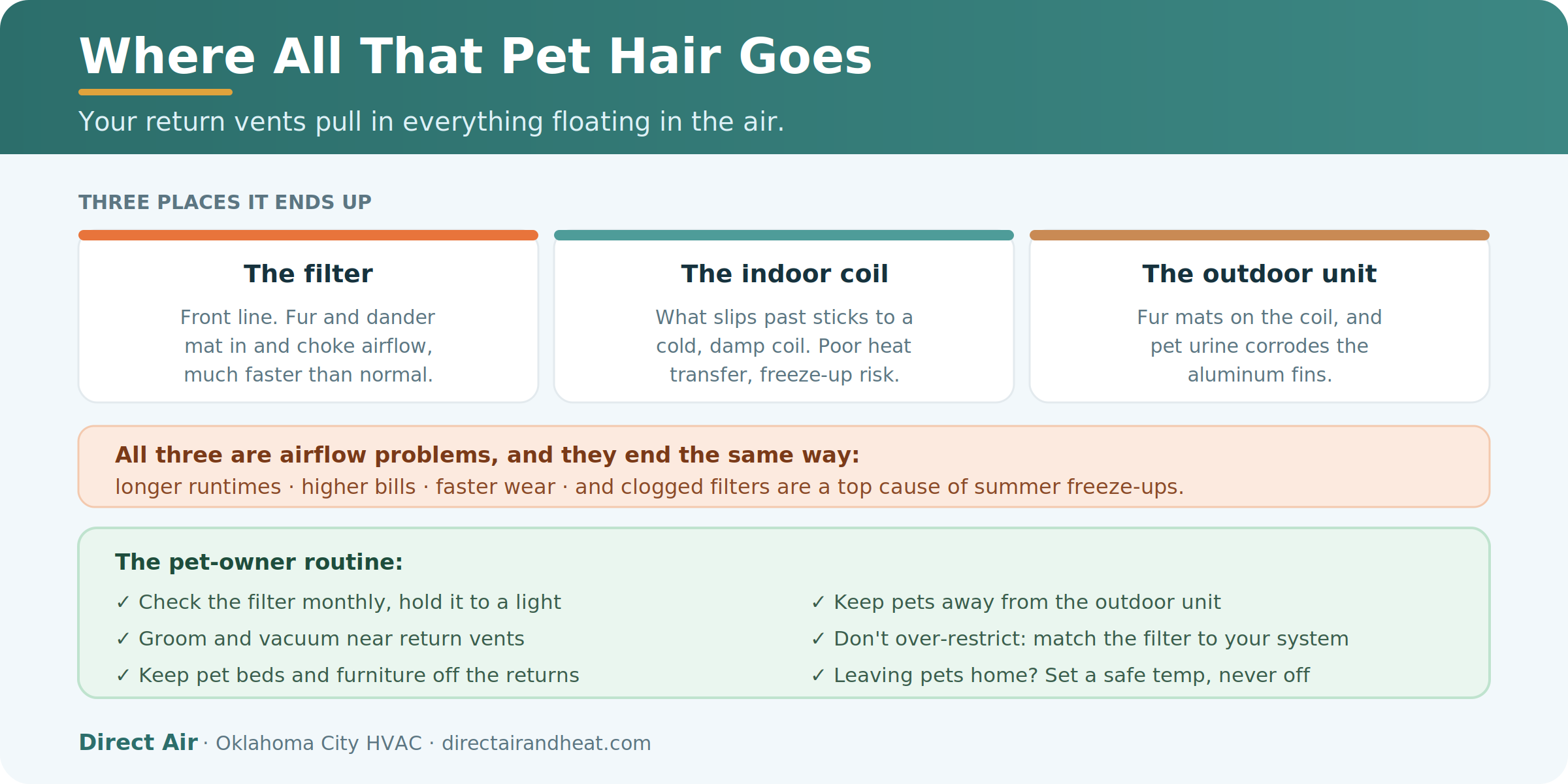
Where the fur actually ends up
Three places, in order of how often they cause trouble:
- The air filter. This is the front line, and it loads up dramatically faster in a pet home. Fur plus dander mats into the filter media and chokes airflow.
- The evaporator coil (indoors). Whatever slips past the filter lands on a cold, damp coil, where it sticks. A furred-over coil can't transfer heat well and contributes to freeze-ups.
- The outdoor condenser unit. Fur blows around the yard and mats onto the outdoor coil alongside our cottonwood and red dirt, and if a pet uses the unit as a favorite spot, urine is genuinely corrosive to those aluminum fins.
What it costs you
Every one of those is an airflow problem, and airflow problems all end the same way: the system runs longer to do the same job, your bill goes up, and components wear faster. A badly clogged filter is also one of the most common causes of a frozen coil in an Oklahoma summer, which turns a maintenance issue into a no-cooling day.
The indoor air side matters too. Dander is a common allergen, and a saturated filter stops capturing it, so the same neglect that raises your bill also puts more of what you're trying to filter back into the air.
What to do about it
None of this is complicated, it's mostly a matter of shortening your intervals:
- Change filters far more often. If a 1-inch filter normally goes 30 to 60 days, a pet home is often at the short end or sooner. Check it monthly by holding it up to a light. If you can't see light through it, replace it, whatever the calendar says.
- Don't jump to the densest filter you can find. A filter too restrictive for your system chokes airflow even when clean. Match the filter to what your system can handle, and change it more often instead.
- Groom and vacuum regularly. Fur caught by a brush or vacuum is fur that never reaches your return vent. Vacuuming near returns and vents helps most.
- Keep return vents clear of pet beds and furniture.
- Protect the outdoor unit. Keep the area around it clear, discourage pets from using it as a marking spot or a napping platform, and rinse the fins gently with a hose on low pressure (power off) if fur is matting on the outside.
- Ask for coil attention at your annual service, since a pet home puts more on the indoor coil than a technician would normally expect.
One comfort note for the pets themselves
If you leave pets home during an Oklahoma summer day, don't shut the AC off entirely. Set it to a temperature that's safe for them rather than purely for savings, and remember that fur-covered animals tolerate heat differently than you do. This is one case where the away setting should be chosen for who's home, not the thermostat math.
Direct Air is a family-owned Oklahoma City HVAC company, and plenty of the homes we serve have pets in them. If your filters load up fast or your system seems to be working harder than it should, we can check the airflow and the coil and get you back on track. Learn more about HVAC filters and service in Oklahoma City, or call us.
Serving Pet Owners Across the OKC Metro
Direct Air keeps systems clean and efficient for homeowners in Mustang, Yukon, Oklahoma City, and throughout the area: Edmond, Norman, Moore, Midwest City, Del City, Choctaw, Nichols Hills, Newcastle, Purcell, El Reno, and Weatherford, OK.
Frequently asked questions
How often should I change my air filter if I have pets? More often than the standard interval. A 1-inch filter that normally lasts 30 to 60 days often needs changing at the short end or sooner in a pet home. Check it monthly by holding it up to a light.
Does pet hair damage an air conditioner? It doesn't damage it directly, but it clogs filters, mats onto the indoor coil, and collects on the outdoor unit. All of that restricts airflow, which raises energy use, strains components, and can cause the coil to freeze.
Should I buy a higher-MERV filter because of my pets? Not necessarily. A filter too restrictive for your system chokes airflow even when clean. Match the filter to your system's specification and change it more frequently instead.
Can my pet damage the outdoor AC unit? Yes. Pet urine is corrosive to the aluminum fins on the condenser coil, and fur can mat onto the outside of the unit. Keep pets away from it and keep the area around it clear.
What temperature should I leave the AC at for pets when I'm away? Set it for their safety rather than purely for savings. In an Oklahoma summer, do not turn the system off entirely with pets at home, and choose a temperature that keeps them comfortable.