
What Your AC Warranty Actually Covers (and What Quietly Voids It)
Most homeowners learn how their AC warranty works at the worst possible moment: the compressor has failed, it's 100 degrees, and they're finding out the coverage they assumed they had either expired, was never activated, or doesn't apply. It's an avoidable kind of bad news, because nearly every warranty problem traces back to a handful of things people didn't know at the time.
Here's the plain-English version, plus what quietly voids coverage. (Your specific terms come from your manufacturer and installer, so treat this as the map, not the contract.)
There are usually two warranties, not one
This trips up almost everyone. A new system typically comes with:
- The manufacturer's parts warranty. Covers the physical components: compressor, coil, control board, and so on, if they fail due to a defect. Commonly around 10 years on major parts when registered, though it varies by brand and model.
- The installer's labor warranty. Covers the work of diagnosing and replacing the part. This is separate, usually much shorter (often a year or two), and offered by the company that installed the system.
The gap between them is where the surprise lives. A "10-year warranty" often means the part is free in year eight, but the labor to get it in is not. Knowing that upfront changes how you plan for repairs.
What's generally NOT covered
- Routine maintenance, filters, tune-ups, cleaning
- Damage from neglect, such as failures caused by a coil nobody ever cleaned
- Storm, flood, power surge, or rodent damage, which is a homeowners insurance question, not a warranty one
- Refrigerant, in many cases, even when the leaking part itself is covered
- Failures from improper installation, which is why the installer matters
- Systems moved to another property, or in some cases, a home sold without transferring the warranty
What quietly voids your warranty
These are the ones that catch people out:
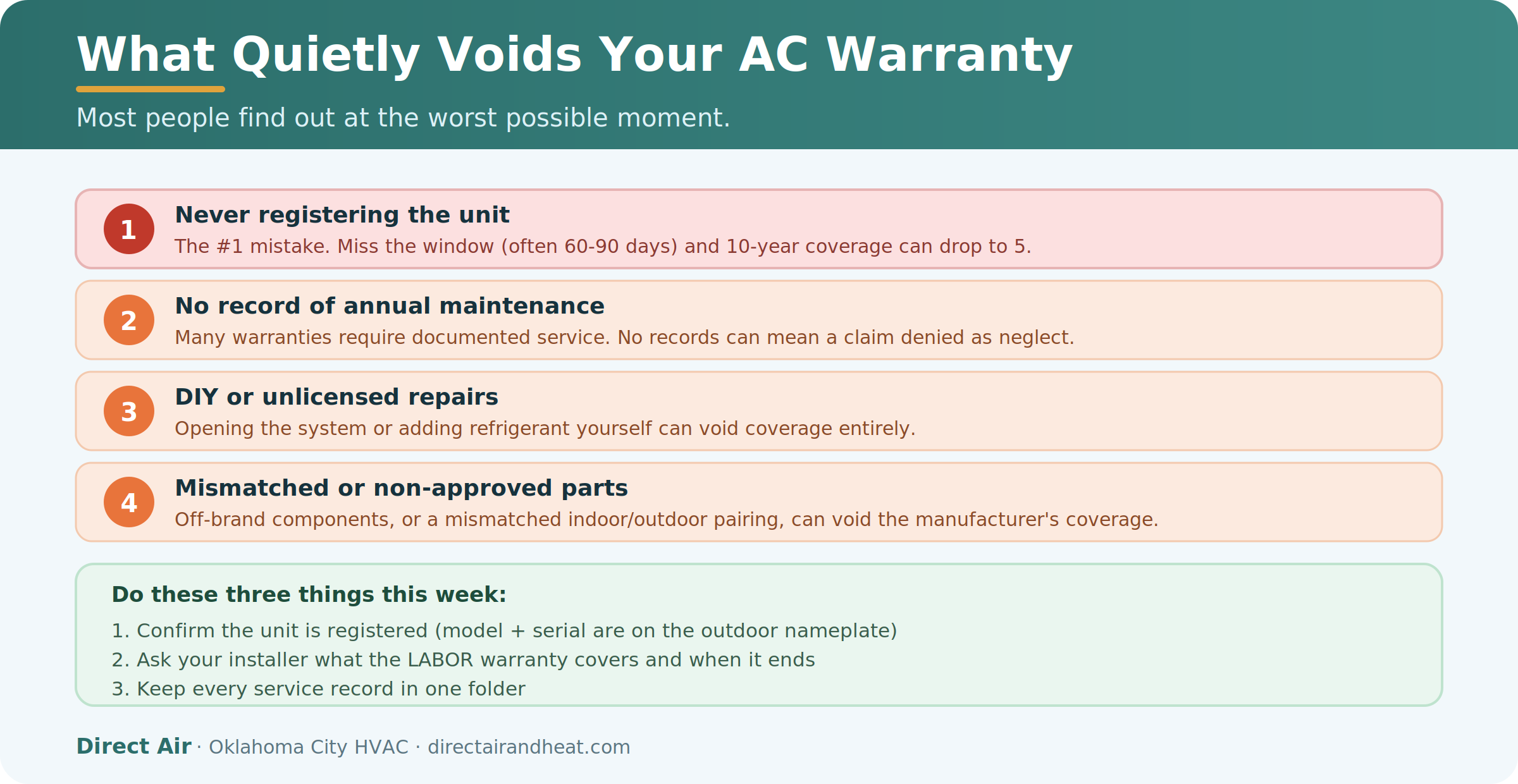
- 1Not registering the unit. This is the single most common mistake. Most manufacturers require registration within a set window after installation (often 60 to 90 days) to get the full parts warranty. Miss it, and you can be dropped to a much shorter base warranty, sometimes 5 years instead of 10. A reputable installer usually handles this, but it is worth confirming it was actually done.
- 2No record of professional maintenance. Many warranties require documented annual servicing. If a claim comes and there are no records, the manufacturer can deny it as neglect. This is the argument for keeping receipts, and it's a real reason a maintenance plan pays for itself.
- 3Work done by an unlicensed person, or DIY repairs. Opening the system, adding refrigerant yourself, or hiring someone unqualified can void coverage entirely.
- 4Non-approved or mismatched parts. Using off-brand replacement components, or pairing an indoor unit with a mismatched outdoor unit, can void the manufacturer's coverage.
- 5Improper installation or sizing. A poorly installed or badly sized system can have claims denied because the failure traces to the install, not a defect.
The three things to do this week
If you have a system under warranty, or you're about to buy one:
- Confirm it's registered. Find your model and serial number (on the outdoor unit's nameplate) and verify registration with the manufacturer. If you're within the window and it wasn't done, do it now.
- Find out what your labor warranty covers and when it ends. Ask your installer directly, and write the date down.
- Start a paper trail. Keep every maintenance and service record in one place. That folder is what protects a future claim.
Why this matters more in Oklahoma
Our systems run five or more months a year, hard. That means more run-hours, more wear, and a higher chance you'll actually need to use the warranty than a homeowner in a mild climate would. It also means the "documented annual maintenance" requirement isn't just paperwork here, since a system working this hard genuinely needs that service to reach its expected life.
Direct Air is a family-owned Oklahoma City HVAC company. We register the systems we install, document every visit, and can tell you honestly where your coverage stands. Learn more about AC maintenance in Oklahoma City, or call us with your model number and we'll help you sort it out.
Serving Homeowners Across the Metro
Direct Air installs, services, and documents systems for homeowners in Moore, Norman, Oklahoma City, and throughout the area: Edmond, Yukon, Mustang, Midwest City, Del City, Choctaw, Nichols Hills, Newcastle, Purcell, El Reno, and Weatherford, OK.
Frequently asked questions
What voids an AC warranty? The most common causes are failing to register the unit in time, having no records of professional annual maintenance, DIY or unlicensed repairs, non-approved or mismatched parts, and failures caused by improper installation.
Do I have to register my new AC for the warranty? Usually yes. Most manufacturers require registration within a set window after installation to receive the full parts warranty. Miss it and you may be dropped to a much shorter base warranty.
Does an AC warranty cover labor? Not usually. The manufacturer typically covers parts, while labor is covered separately by the installer for a shorter period. So a covered part can still come with a labor charge years later.
Does my warranty require annual maintenance? Many do, and they can require documentation. If a claim is filed with no record of professional servicing, the manufacturer may deny it as neglect, which is why keeping service records matters.
Is refrigerant covered under warranty? Often not. Even when a leaking component is covered as a part, the refrigerant itself and the labor to recharge the system frequently are not. Check your specific terms.