
Is My AC Low on Refrigerant?
Before the symptoms, one fact that changes how you should think about this entire topic: refrigerant is not a fuel. Your air conditioner does not burn it, consume it, or use it up. It circulates the same refrigerant in a sealed loop, year after year, the way a refrigerator does.
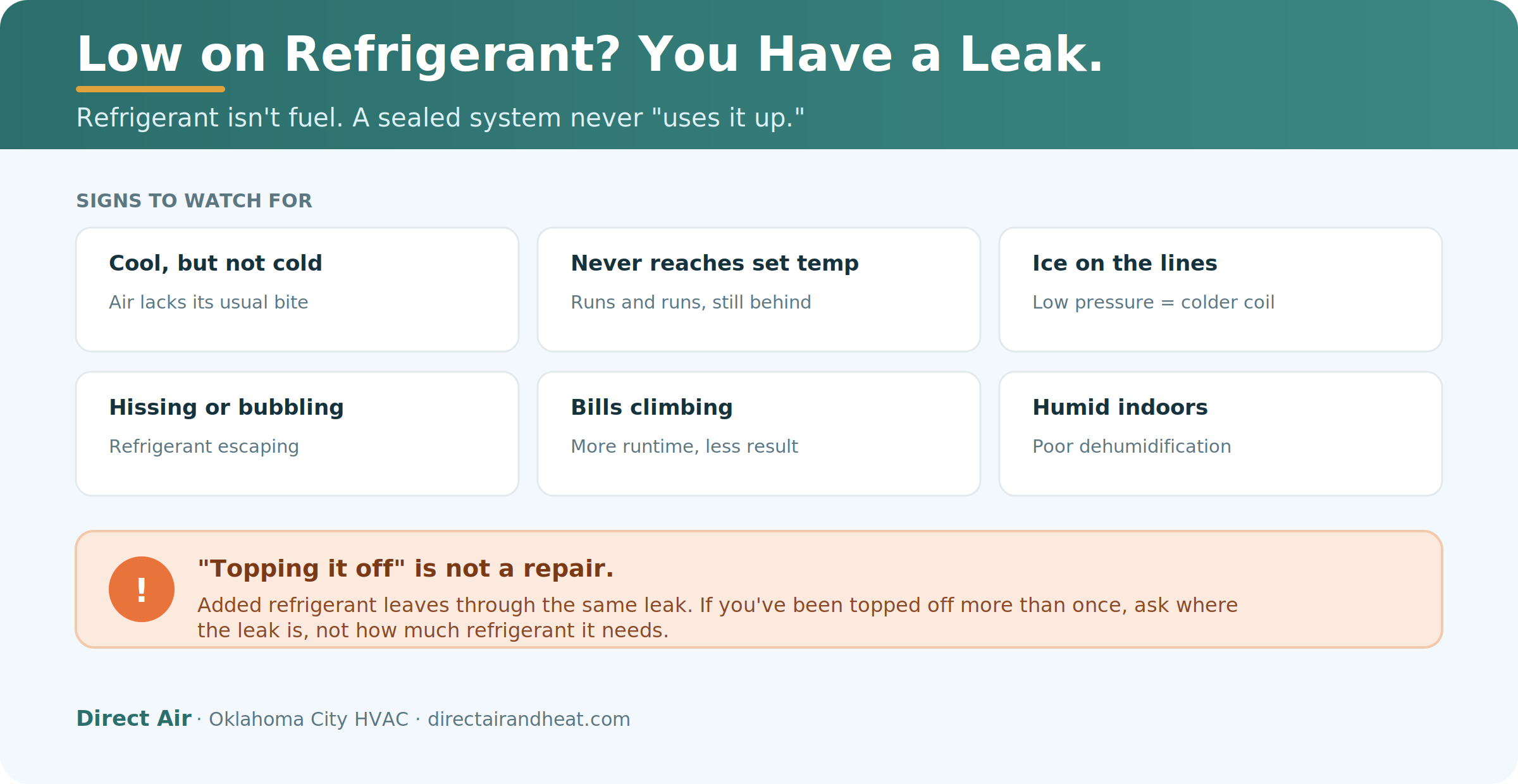
Which leads to the conclusion most homeowners never get told: if your system is genuinely low on refrigerant, it did not "run out." It leaked. And that distinction matters, because it changes what a proper repair looks like.
The signs your AC is low
Low refrigerant reduces the system's ability to absorb heat, and that shows up in fairly recognizable ways:
- Air from the vents is cool but not cold. The system runs, but the air lacks its usual bite.
- It runs and runs without reaching the set temperature. Reduced capacity means it can never quite catch up, especially on hot afternoons.
- Ice on the refrigerant lines or indoor coil. Lower pressure makes the refrigerant colder than designed, so the coil freezes. Counterintuitive but very common.
- Hissing or bubbling sounds near the lines or indoor unit, which can indicate refrigerant escaping.
- Energy bills climbing while comfort drops, because the system runs far longer for less result.
- The house feels humid even while the AC runs, since a struggling system dehumidifies poorly.
Any one of these has other possible explanations. Several together point strongly at refrigerant.
Why "just topping it off" is a red flag
Here is where homeowners get quietly overcharged year after year. If a technician adds refrigerant and leaves without finding the leak, you have bought yourself a temporary fix, and you will be making the same call next summer, and the summer after. Refrigerant that was added has to go somewhere, and it goes right back out through the same leak.
Adding refrigerant without repairing the leak is not a repair. It is a recharge on a countdown timer. So if you have been told your system "needs a top-off" more than once, the right question to ask is not how much refrigerant it needs, but where the leak is and what it will take to fix it. Sometimes the honest answer is that the leak is in a component (like an aging evaporator coil) where repair costs approach replacement, and that is a legitimate repair-or-replace conversation worth having openly.
Why you should not DIY this
Refrigerant is not a hardware store fix, for a few real reasons. Handling it requires EPA certification, because venting refrigerant is both environmentally harmful and illegal. Systems must be charged to a precise specification, and overcharging damages the compressor just as surely as undercharging starves it. The DIY recharge cans sold for cars are not appropriate for a home system. And most importantly, adding refrigerant does nothing about the leak that caused the problem.
What a proper repair looks like
- 1Diagnosis, confirming that low refrigerant is actually the issue rather than airflow, a dirty coil, or a failing component.
- 2Leak detection, locating where the refrigerant is escaping.
- 3Repair, fixing the leak or, where the leaking component is beyond economical repair, discussing your options honestly.
- 4Recharge, to the manufacturer's exact specification.
- 5Verification, confirming the system holds pressure and performs correctly.
If your system still uses phased-out R-22 refrigerant, this conversation shifts. R-22 is expensive and increasingly hard to source, so a significant leak in an older R-22 unit often makes replacement the more sensible investment.
Direct Air is a family-owned Oklahoma City HVAC company, and our EPA-certified technicians find the leak rather than selling you the same recharge every summer. If your cooling is weak and your bills are climbing, let us diagnose it properly. Schedule AC repair in Oklahoma City.
Refrigerant and AC Repair Service Nearby
Direct Air diagnoses and repairs refrigerant leaks for homeowners in Norman, Newcastle, Oklahoma City, and across the metro: Edmond, Moore, Yukon, Mustang, Midwest City, Del City, Choctaw, Nichols Hills, Purcell, El Reno, and Weatherford, OK.
Frequently asked questions
Does an AC use up refrigerant over time? No. Refrigerant circulates in a sealed loop and is not consumed. If your system is low, it has a leak, which is why simply adding more is a temporary fix rather than a repair.
What are the signs of low refrigerant? Air that is cool but not cold, run times that never reach the set temperature, ice on the refrigerant lines or coil, hissing or bubbling sounds, rising energy bills, and a house that feels humid while the AC runs.
Why does low refrigerant cause my AC to freeze up? Lower pressure in the system makes the refrigerant colder than designed. The coil surface drops below freezing, and moisture in your air freezes onto it, which then chokes airflow and makes the ice worse.
Can I add refrigerant to my AC myself? No. Handling refrigerant requires EPA certification, systems must be charged to an exact specification, and overcharging damages the compressor. It also does nothing about the underlying leak.
Is a refrigerant leak worth repairing? Often yes, especially on a newer system. But if the unit is old, uses phased-out R-22, or the leak is in a major component like the evaporator coil, replacement may be the better long-term value.