
Single-Stage vs. Two-Stage vs. Variable-Speed AC: What's the Difference?
When you shop for a new air conditioner, the SEER2 number gets all the attention, but there's a second spec that shapes your daily comfort just as much: how the system runs. You'll see units described as single-stage, two-stage, or variable-speed, and the difference between them is basically the difference between a light switch and a dimmer.
Here's what each one actually does, and which makes sense for an Oklahoma home.
The simplest way to think about it
Imagine driving a car with only two options: full throttle or completely stopped. That's a single-stage AC. Now imagine having a low gear and a high gear. That's two-stage. Finally, imagine a smooth accelerator that gives you exactly the speed you need at any moment. That's variable-speed. All three cool your home. They just do it with very different levels of finesse, and that finesse is what you feel in comfort, humidity, and your electric bill.
Single-stage: on or off
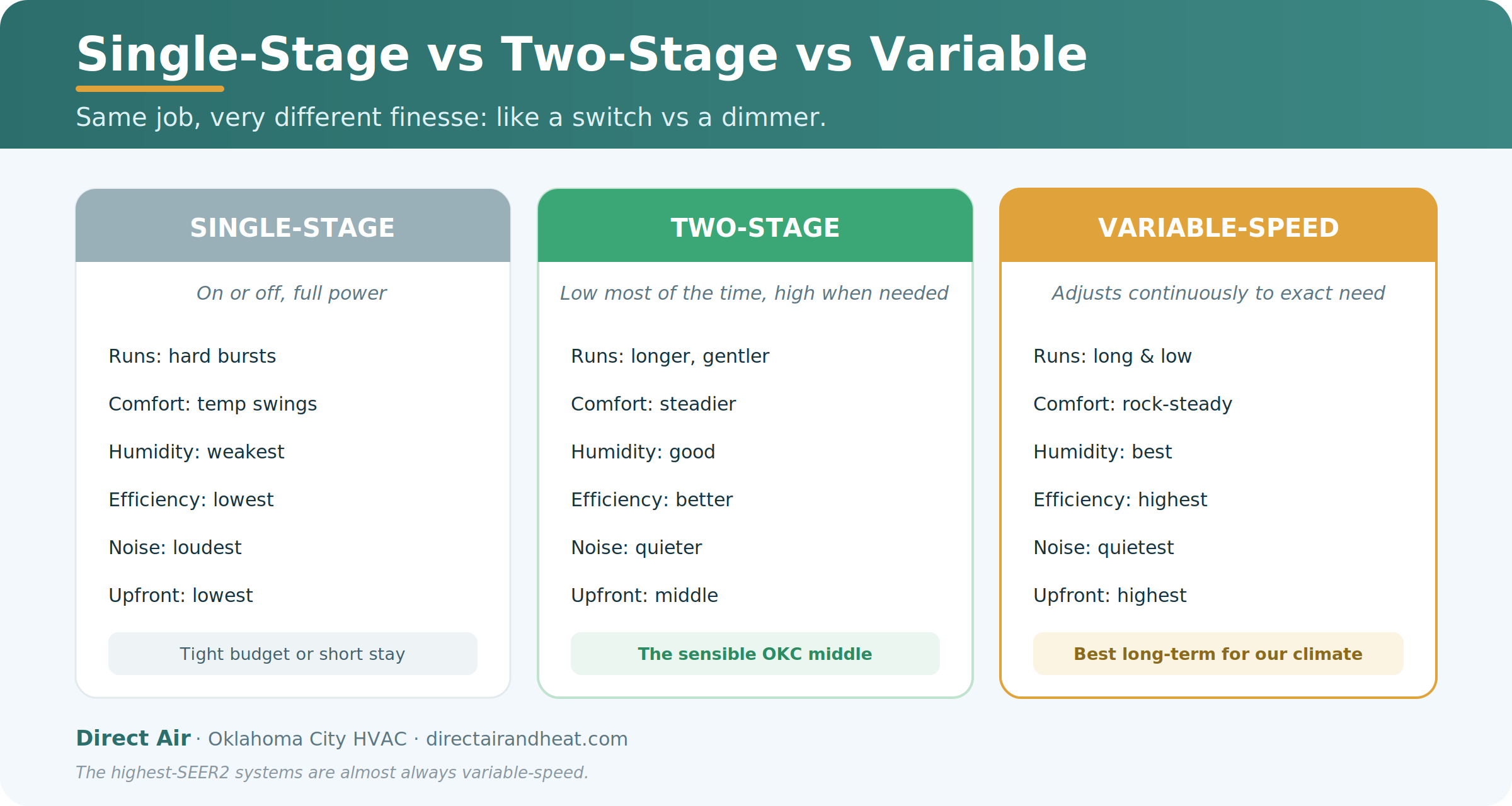
A single-stage AC has one speed: 100 percent. When the thermostat calls for cooling, it blasts at full power until the target is reached, then shuts off completely. It's the most affordable option upfront and perfectly functional. The trade-offs are that it runs in noticeable bursts, tends to cool in a "cold then warm then cold" cycle, is the least efficient of the three over a long season, and does the least for humidity, because those short, hard cycles don't run long enough to wring much moisture out of the air. In our humid summers, that last point matters.
Two-stage: high and low
A two-stage AC has two settings: a low stage for most conditions and a high stage for the hottest stretches. Because it can run on low most of the time, it operates in longer, gentler cycles rather than hard bursts. That means steadier temperatures with fewer swings, better humidity control (those longer low-stage runs remove more moisture), improved efficiency over single-stage, and quieter operation. It costs more upfront than single-stage, but for our climate the comfort and dehumidification gains are real.
Variable-speed: exactly as much as needed
A variable-speed AC (sometimes called modulating or inverter) can run at a wide range of outputs, often from around 25 percent up to 100 percent, adjusting continuously to match your home's exact need. Instead of cycling on and off, it tends to run long and low, sipping energy while holding your temperature rock-steady. This is the top tier, and it delivers the most even comfort with almost no temperature swings, the best humidity control by far (near-constant low-speed running is ideal for moisture removal), the highest efficiency and lowest running costs, and the quietest operation. The catch is the highest upfront cost, so the question is whether the long-term comfort and savings justify it for you.
Which is right for an Oklahoma home?
Our long, hot, humid cooling season tilts this decision more than it would in a milder place, because you run the system so many hours that both efficiency and humidity control pay off more here:
- Single-stage makes sense on a tight budget, for a rental or a home you'll sell soon, or where upfront cost is the deciding factor.
- Two-stage is the sensible middle for many OKC homeowners: a meaningful jump in comfort, humidity control, and efficiency without the top-tier price.
- Variable-speed is the best long-term choice if you're staying put, you run your AC hard all summer (most of us do), and comfort and low bills matter more than the initial outlay. Over our five-plus months of cooling, it recovers more of its cost than it would up north.
How this connects to SEER2
The two specs are related. The highest-SEER2 systems are almost always variable-speed, because precise modulation is how they hit those efficiency numbers. So as you climb the SEER2 tiers, you're usually also climbing from single-stage to two-stage to variable-speed. That's worth knowing when you compare quotes: a big efficiency number and "variable-speed" tend to travel together, and so does the price.
The catch that applies to all three
Staging only delivers if the system is sized and installed correctly. An oversized variable-speed unit loses much of its humidity advantage, and any system feeding leaky ducts in a 130-degree attic won't perform to its rating. So the stage you choose matters, but a proper load calculation and a good install matter just as much.
Direct Air is a family-owned Oklahoma City HVAC company, and we'll walk you honestly through single-stage, two-stage, and variable-speed based on your home, your budget, and how long you plan to stay, not just the biggest number on the shelf. Explore your options for AC installation and replacement in Oklahoma City, or contact us to talk it through.
AC Installation Across the OKC Metro
Direct Air installs single-stage, two-stage, and variable-speed systems for homeowners in Edmond, Oklahoma City, Norman, and throughout the area: Moore, Yukon, Mustang, Midwest City, Del City, Choctaw, Nichols Hills, Newcastle, Purcell, El Reno, and Weatherford, OK.
Frequently asked questions
What is the difference between single-stage, two-stage, and variable-speed AC? Single-stage runs at one speed (full power on or off). Two-stage has a low and high setting for longer, gentler cycles. Variable-speed adjusts continuously to match your exact need, running long and low for the steadiest comfort and best efficiency.
Is a variable-speed AC worth the extra cost? Often yes in Oklahoma, because our long cooling season means you run the system enough for the efficiency and humidity-control gains to add up. It's the best choice for long-term owners who run their AC hard; single or two-stage may suit tighter budgets or shorter stays.
Which stage is best for humidity control? Variable-speed is best, because near-constant low-speed running removes the most moisture. Two-stage is a strong middle option. Single-stage does the least, since its short cycles don't run long enough to dehumidify well.
Do two-stage and variable-speed ACs lower energy bills? Yes, both are more efficient than single-stage over a season, with variable-speed the lowest to run. The highest-SEER2 systems are almost always variable-speed.
Does the AC stage matter if my ducts leak? Yes. Even the best variable-speed unit won't deliver its rated comfort or efficiency if it's feeding leaky ducts or was sized incorrectly. Proper sizing and sealed ductwork are essential to getting what you paid for.