Summer Storms and Your AC: Outages, Surges, and What to Do
Oklahoma summers do not just bring heat. They bring the storms that come with it: thunderstorms, high wind, hail, lightning, and the power outages that follow. All of that lands during the exact months your air conditioner is working hardest, and storms can hurt an AC in ways that are not obvious until you try to turn it back on. Knowing what to do in the minutes and hours after a storm can be the difference between a smooth restart and an expensive repair.
After the power comes back: wait before you cool
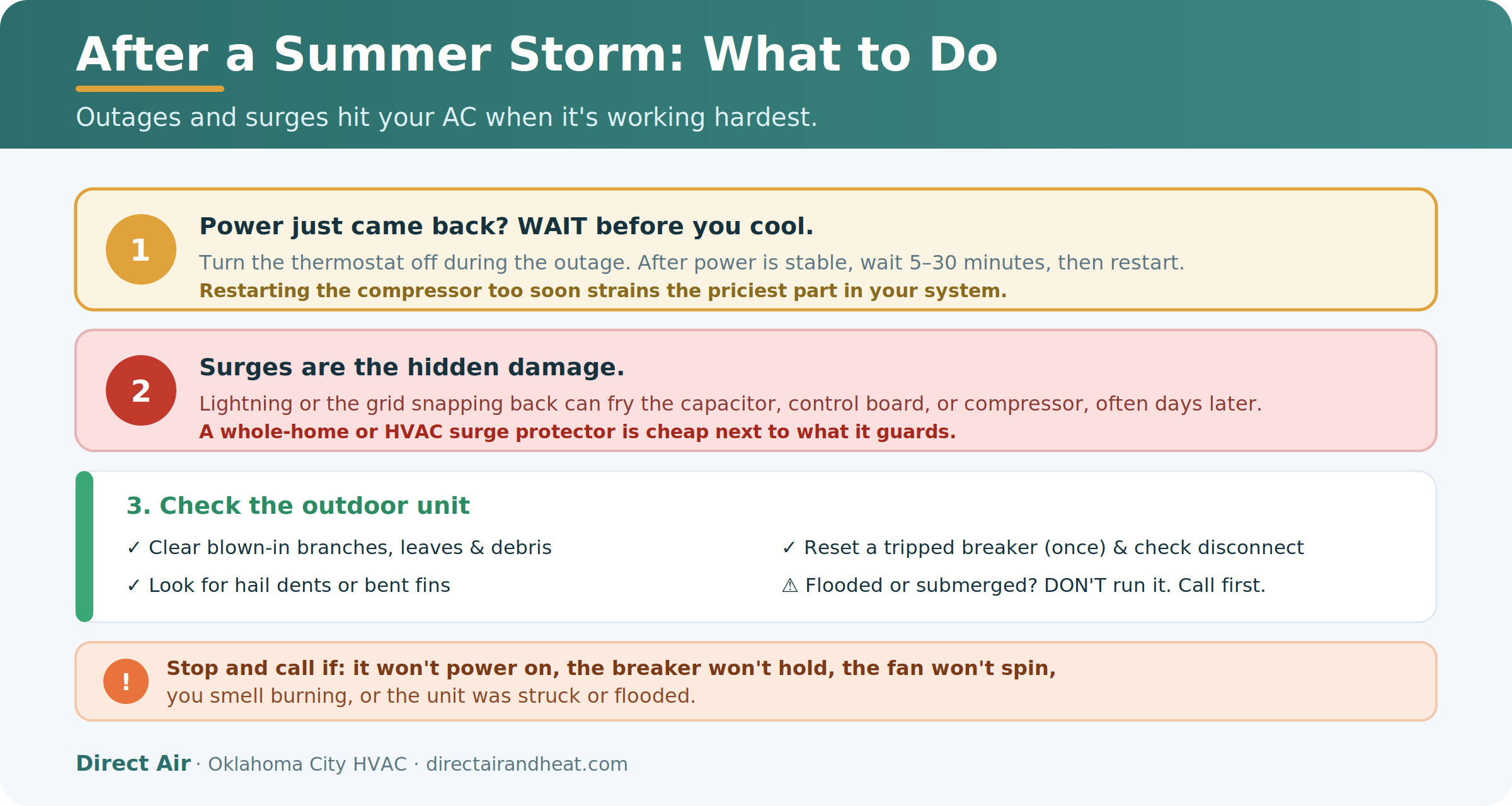
This is the single most important habit, and almost nobody knows it. When the power returns after an outage, do not immediately switch the AC back to cooling. Wait at least a few minutes, ideally 5 to 30. Here is why: restarting the compressor before the internal pressures have equalized puts a hard strain on it, and the moment power is restored to the grid is also when surges are most likely. Give it a beat.
Practically:
- 1When the power drops, turn your thermostat to Off so the system is not trying to restart the instant power returns.
- 2Once power is stable, wait a few minutes, then switch cooling back on.
- 3Many smart and modern thermostats have a built-in delay that does this for you, but doing it manually costs nothing.
That short pause protects the most expensive part of your system, the compressor, from the worst moment to restart.
Power surges are the hidden storm damage
An outage is the obvious problem. The surge is the sneaky one. A lightning strike, or the spike when grid power snaps back on, can send a jolt through your home's wiring that fries sensitive AC components, the capacitor, the control board, even the compressor. The frustrating part is that surge damage often does not show up until later, when the system will not start on the next hot day and you have long since forgotten the storm.
The fix is protection, not reaction. A whole-home surge protector at your electrical panel, or a dedicated surge protector for the HVAC system, guards your AC (and everything else) against exactly these spikes. In a state with our storm frequency, it is one of the better-value protections you can add, far cheaper than the compressor or control board it is guarding.
Check the outdoor unit after the storm
Once the weather clears, give the outdoor unit a look before you lean on the system:
- Clear debris. Storms blow branches, leaves, and trash into and around the unit. Clear it so the coil can breathe.
- Look for physical damage. Hail and flying debris can dent the unit or bend the fins. Bent fins block airflow.
- Check for flooding. This one matters: if the outdoor unit was submerged or sitting in standing water, do not run it. Water in the electrical components and bearings can cause a dangerous short or serious damage. Have it inspected first.
- Reset the basics. If the system will not start, check for a tripped breaker (reset once) and confirm the outdoor disconnect was not knocked off.
Signs the storm got your system
Suspect storm or surge damage if, after the weather passes:
- The AC will not turn on at all, or the thermostat is dead despite power elsewhere in the house
- The breaker trips immediately when you try to run it
- The outdoor unit hums but the fan will not spin (a common post-surge capacitor failure)
- You smell burning or see any scorching at the unit or panel
- The unit was flooded or visibly struck
Any of those, especially burning smells or a breaker that will not hold, means stop and call rather than forcing it.
The best time to prepare is before the next one
Oklahoma will have another storm, that is a safe bet. The homeowners who ride them out easily are the ones who added surge protection before they needed it and who know to pause the system after an outage rather than slamming it back on. A little preparation turns a storm from a potential repair into a non-event.
Direct Air is a family-owned Oklahoma City HVAC company, and storm-season no-cool calls are part of what we do. If your system took a hit, or you want surge protection installed before the next one, we are here. Learn more about our AC service in Oklahoma City, or contact us to get storm-ready.
Storm-Season Service Across the Metro
Direct Air helps homeowners recover from storm-season AC trouble in Moore, Norman, Oklahoma City, and throughout the area: Edmond, Yukon, Mustang, Midwest City, Del City, Choctaw, Nichols Hills, Newcastle, Purcell, El Reno, and Weatherford, OK.
Frequently asked questions
Should I turn my AC back on right after the power returns? No. Wait at least a few minutes, ideally 5 to 30. Restarting the compressor before internal pressures equalize strains it, and the moment power returns is when surges are most likely. Turn the thermostat off during the outage, then restart after power is stable.
Can a power surge damage my air conditioner? Yes. A lightning strike or the spike when grid power returns can damage the capacitor, control board, or compressor, and the damage may not appear until the next time you run the system. A whole-home or HVAC surge protector guards against this.
My AC won't turn on after a storm. What should I check? Check for a tripped breaker (reset once), confirm the outdoor disconnect wasn't knocked off, and clear debris from the outdoor unit. If it was flooded, hums without the fan spinning, trips the breaker again, or smells burnt, stop and call a professional.
Is it safe to run my AC if the outdoor unit was flooded? No. If the unit sat in standing water or was submerged, do not run it. Water in the electrical parts and bearings can cause a short or serious damage. Have it inspected before use.
How can I protect my AC from storm damage? Add a whole-home surge protector or a dedicated HVAC surge protector, pause the system after outages before restarting, and keep the area around the outdoor unit clear so storm debris causes less trouble.