
Why Is My AC Freezing Up in the Middle of Summer?
It is 100 degrees outside and there is ice on your air conditioner. That feels like it should be impossible, and it is exactly why this problem confuses so many homeowners. But a frozen AC in July is not a freak event. It is one of the most common summer service calls, and the ice is a symptom, not the disease.
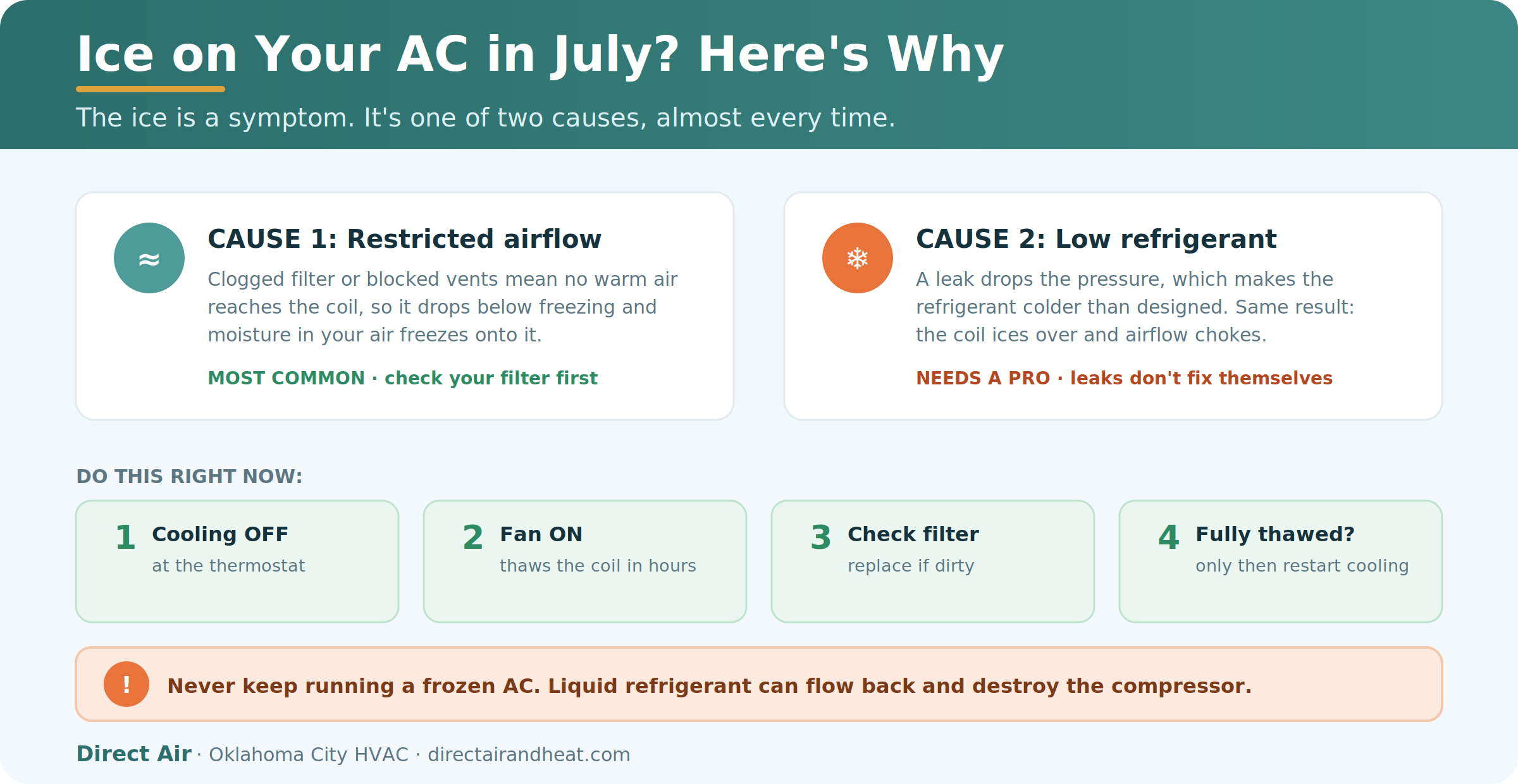
Here is what is actually happening, what to do the moment you spot it, and the one mistake that turns a frozen coil into a dead compressor.
Why ice forms when it's hot out
Your AC's indoor coil is filled with refrigerant that runs very cold. Under normal operation, warm air from your home constantly blows across that coil, which keeps its surface above freezing while the refrigerant absorbs the heat. The ice appears when that balance breaks in one of two ways:
- 1Not enough warm air is reaching the coil. Restricted airflow means nothing is warming the coil surface, so it drops below freezing and the moisture in your air freezes onto it. The ice then blocks even more airflow, which makes it colder, which makes more ice. It snowballs.
- 2Not enough refrigerant is in the system. A leak lowers the pressure, and lower pressure makes the refrigerant colder than designed. The coil surface drops below freezing and the same snowball starts.
So the outdoor temperature is irrelevant. Ice means either airflow or refrigerant, almost every time.
What to do right now
- 1Turn the cooling off. At the thermostat, switch the system from Cool to Off.
- 2Set the fan to On. Running just the fan blows warm air across the coil and melts the ice from the inside, usually within a few hours.
- 3Check your filter while you wait. A clogged filter is the single most common cause of a frozen coil. If it is dirty, replace it.
- 4Check your vents. Make sure supply and return vents are open and not blocked by furniture or rugs.
- 5Do not restart cooling until the ice is fully gone. Water dripping from the unit as it thaws is normal; put a towel down if needed.
If the filter was filthy and the system runs normally after thawing, you likely found your cause. Keep an eye on it for a day or two.
The mistake that kills compressors
The worst thing you can do is see the ice, decide the AC just needs to "push harder," and leave it running. A frozen coil starves the system, and refrigerant that should be evaporating can slug back to the compressor as liquid, which compressors do not survive. Running a frozen AC is how a fixable problem becomes a replacement conversation. When in doubt: off, fan on, thaw.
When it's a job for a pro
Call for service if any of these are true:
- The ice comes back after a thaw and a fresh filter
- The filter was clean, which points away from airflow and toward refrigerant
- You hear hissing or bubbling near the lines, a classic leak sign
- Airflow from the vents stays weak even after thawing
A refrigerant leak will not fix itself, and topping off without repairing the leak just schedules the same failure for later in the summer. A technician can test, find the leak, repair it, and charge the system correctly.
Direct Air is a family-owned Oklahoma City HVAC company, and frozen systems are one of our most common heat-wave calls. If yours keeps icing up, let us find the actual cause instead of thawing it on repeat. Schedule AC repair in Oklahoma City.
AC Repair Throughout the Metro
Direct Air diagnoses and repairs frozen and failing systems for homeowners in Weatherford, El Reno, Yukon, and across the OKC area: Oklahoma City, Edmond, Norman, Moore, Mustang, Midwest City, Del City, Choctaw, Nichols Hills, Newcastle, and Purcell, OK.
Frequently asked questions
Why is my AC freezing up when it's hot outside? Because ice on the coil comes from inside the system, not outside weather. Either restricted airflow (usually a clogged filter) or low refrigerant from a leak lets the coil surface drop below freezing, and moisture in your air freezes onto it.
Can I keep running my AC if it's frozen? No. Running a frozen system can send liquid refrigerant back to the compressor and destroy it. Turn cooling off, run the fan to thaw the coil, and find the cause before restarting.
How long does a frozen AC take to thaw? With the system off and the fan running, usually a few hours. Never chip or pry ice off the coil, since the fins damage easily.
Will replacing the filter fix a frozen AC? Often, yes. A clogged filter is the most common cause. But if the ice returns with a clean filter, the likely culprit is a refrigerant leak, which needs professional repair.
Is a refrigerant leak an emergency? It will not fix itself and it gets worse, so treat it as urgent. Topping off without repairing the leak only delays the same failure.