
Why Is My AC Running Constantly and Never Shutting Off?
First, the answer nobody else leads with: during a genuine Oklahoma heat wave, an AC that runs almost nonstop might be doing exactly what it should. When it is 103 outside and you want 75 inside, your system is fighting a 28-degree gap for hours on end, and a correctly sized unit will run long, steady cycles to hold the line. Long run times in extreme heat are not automatically a problem.
The question that matters is different: is it running constantly and keeping up, or running constantly and losing? That distinction tells you whether you are watching normal summer operation or a system crying for help.
The one-question test
Check your thermostat. Is the actual indoor temperature at or near your set point?
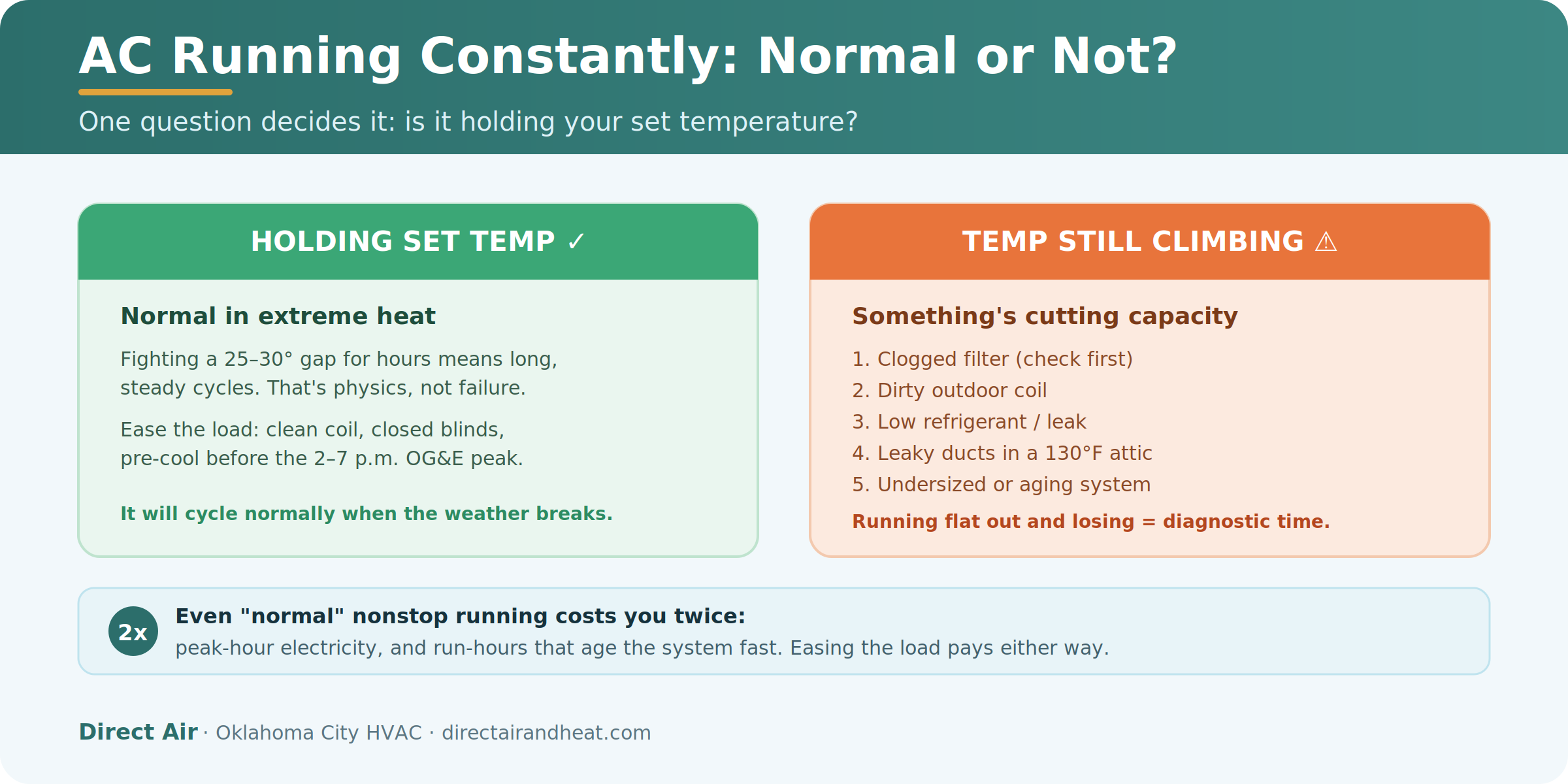
- Yes, it's holding the set temperature. Your AC is running long because the heat load is enormous. That is physics, not failure. It will cycle normally again when the weather breaks.
- No, the indoor temperature is above the set point and not catching up. Now you have a real problem. The system is running flat out and still losing ground, which means something is reducing its capacity.
Everything below is about that second case.
What makes an AC run constantly without keeping up
In rough order of likelihood:
- 1A clogged air filter. Restricted airflow cuts the system's capacity. Cheapest fix on the list, check it first.
- 2A dirty outdoor coil. A condenser caked in dust, grass clippings, and cottonwood cannot dump heat, so the system loses cooling power exactly when it needs it most.
- 3Low refrigerant. A leak reduces capacity, and the system compensates by running forever. Often paired with ice on the lines or weak, not-very-cold air.
- 4Leaky ductwork. You are producing enough cool air, but a chunk of it is escaping into a 130-degree attic before reaching your rooms.
- 5An undersized or aging system. A unit too small for the home, or one worn down by years of Oklahoma summers, simply cannot meet the load anymore.
- 6Poor insulation and air leaks. Heat pours in as fast as the AC removes it, so the finish line keeps moving.
Why constant running matters even when it's "normal"
Even when long run times are legitimate, they are expensive in two ways. The obvious one is your electric bill, especially during OG&E's 2 to 7 p.m. peak window when afternoon runtime costs the most. The less obvious one is wear: a system that never rests accumulates run-hours fast, and in Oklahoma that is exactly how a 15-year lifespan becomes 12. So even for a healthy system, easing the load pays. Shade the condenser's area, keep the coil clean, close blinds on west windows, and pre-cool before the afternoon peak instead of asking the AC to sprint through it.
What you can do before calling anyone
- 1Replace the filter if it is dirty
- 2Gently rinse the outdoor coil with a garden hose (system off first)
- 3Clear grass, leaves, and debris at least two feet around the outdoor unit
- 4Open all supply vents and confirm none are blocked
- 5Close blinds on sun-facing windows during the afternoon
If the system still cannot reach the set point after that, the remaining causes (refrigerant, ducts, capacity) are diagnostic work.
Direct Air is a family-owned Oklahoma City HVAC company. If your AC is running around the clock and losing the fight, we can find out which of these causes it actually is instead of guessing. Schedule AC repair in Oklahoma City.
Serving the Greater OKC Area
Direct Air keeps cooling systems running strong for homeowners in Edmond, Nichols Hills, Oklahoma City, and throughout the metro: Norman, Moore, Yukon, Mustang, Midwest City, Del City, Choctaw, Newcastle, Purcell, El Reno, and Weatherford, OK.
Frequently asked questions
Is it normal for my AC to run constantly in extreme heat? Yes, if it is holding your set temperature. In 100-degree-plus weather a correctly sized system runs long, steady cycles. It becomes a problem when it runs constantly and the indoor temperature still climbs.
How do I know if my constantly running AC has a real problem? Check whether the indoor temperature matches your set point. Holding steady means heavy but normal operation. Falling behind means something, most often a dirty filter, dirty coil, refrigerant leak, or duct loss, is cutting the system's capacity.
Does a dirty outdoor unit make my AC run longer? Yes. A coil caked in dust and debris cannot release heat, which reduces cooling capacity and forces longer run times. Rinsing it gently with a hose (system off) often helps noticeably.
Will a constantly running AC wear out faster? Yes. Lifespan tracks run-hours, and nonstop operation accumulates them quickly, which is one reason Oklahoma systems age faster than the national average.
Why does my AC run all afternoon but catch up at night? The afternoon heat load, especially through west-facing windows, can exceed what the system can remove per hour. Once the sun drops, the load falls and the AC catches up. Shading, blinds, and pre-cooling before the afternoon reduce the gap.