
SEER2 in 2026: What the Rules Mean for Your Next AC
If you have shopped for an AC recently, you have seen "SEER2" on every unit and probably wondered whether it is real information or marketing noise. It is real, and it is worth two minutes to understand, because it is the single number that tells you how much a system will cost to run every summer, and it is also the reason new AC prices jumped a couple of years ago.
Here is the plain-English version, with the numbers that actually apply to an Oklahoma home.
What SEER2 actually measures
SEER2 stands for Seasonal Energy Efficiency Ratio 2. Think of it like miles per gallon for your air conditioner: it measures how much cooling you get for the electricity you put in, across a whole season. A higher SEER2 means more cooling per dollar of power, which means a lower summer bill for the same comfort.
The "2" matters. In 2023 the Department of Energy changed the test used to rate efficiency, making it more realistic by simulating the air pressure a system actually works against in a real home. Because the new test is tougher, SEER2 numbers run a little lower than the old SEER numbers for the exact same equipment, roughly 4 to 5 percent lower. So a unit that was "15 SEER" under the old test is about "14.3 SEER2" under the new one. Same machine, more honest number.
Oklahoma's minimum: 14.3 SEER2
This is the part to actually remember. The rules are set by climate region, and Oklahoma is in the DOE's Southeast region. That means any new residential split-system AC installed here must be at least:
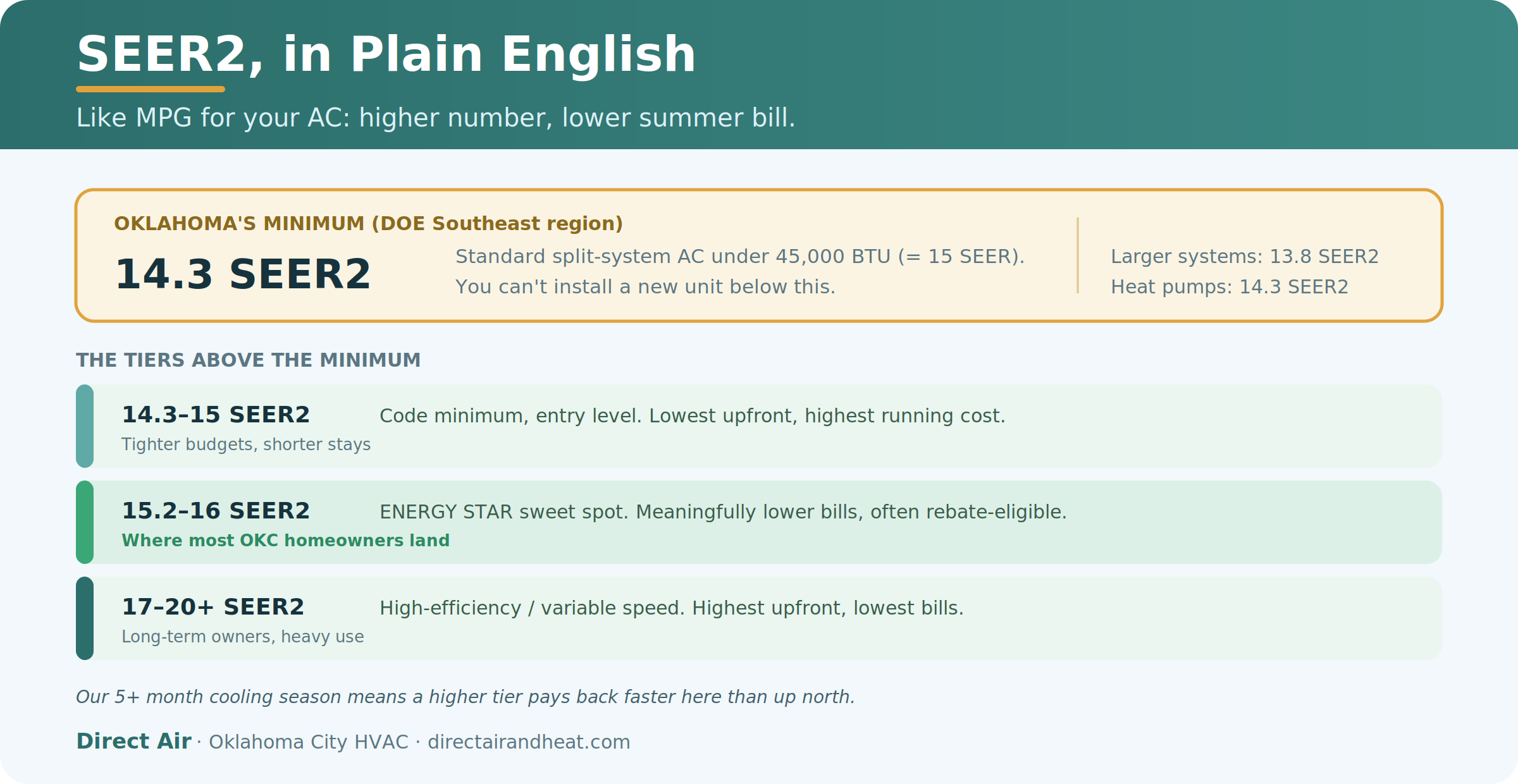
- 14.3 SEER2 (equal to 15 SEER) for standard-size systems under 45,000 BTU, which covers most homes
- 13.8 SEER2 for larger systems at 45,000 BTU and above
- 14.3 SEER2 for heat pumps
You cannot install a new unit below those minimums. The old entry-level "14 SEER" units are gone from the market here, which is exactly why the floor for a new system moved up, and prices with it.
Why the standard is stricter in Oklahoma than up north
It is not arbitrary. The Northern region's minimum is lower (13.4 SEER2) because those states have short, mild cooling seasons. Oklahoma and the rest of the South run their air conditioners hard for five or more months a year, so the DOE sets a higher efficiency floor here, since the savings from an efficient unit add up over far more running hours. In other words, the stricter standard exists precisely because efficiency matters more in our climate.
What SEER2 means for your bill (and your buying decision)
Meeting the minimum is the floor, not the ceiling. You can buy well above 14.3 SEER2, and in Oklahoma's long cooling season, stepping up often pays for itself. Roughly how the tiers shake out:
- 14.3 to 15 SEER2, the code-minimum, entry-level tier. Lowest upfront cost, highest running cost.
- 15.2 to 16 SEER2, the ENERGY STAR sweet spot most OKC homeowners land on. Meaningfully lower bills, and often eligible for rebates.
- 17 to 20+ SEER2, high-efficiency and variable-speed systems. Highest upfront cost, lowest bills, best for long-term owners and heavy use.
Because we cool for so much of the year, the extra upfront cost of a higher-SEER2 system is recovered faster here than it would be in a milder climate. That is the real decision SEER2 is asking you to make: pay less now and more each month, or more now and less each month.
One catch worth knowing
A high SEER2 rating is a lab number. It assumes the system is correctly sized, properly installed, and moving air through sound ductwork. A 17 SEER2 unit that is oversized, or feeding leaky ducts in a 130-degree attic, will not deliver its rated efficiency. So the SEER2 number matters, but the sizing and installation matter just as much, which is worth remembering when you compare quotes.Direct Air is a family-owned Oklahoma City HVAC company, and we will help you weigh the SEER2 tiers honestly against how long you plan to stay and how much you run your system, rather than just selling you the biggest number. Explore air conditioner replacement in Oklahoma City.
High-Efficiency AC Installation Across the Metro
Direct Air installs SEER2-compliant systems for homeowners in Bethany, Warr Acres, Oklahoma City, and throughout the area: Edmond, Norman, Moore, Yukon, Mustang, Midwest City, Del City, Choctaw, Nichols Hills, Newcastle, Purcell, El Reno, and Weatherford, OK.
Frequently asked questions
What is SEER2? SEER2 (Seasonal Energy Efficiency Ratio 2) measures how much cooling an AC delivers per unit of electricity across a season, like miles per gallon for your air conditioner. A higher number means lower running costs. It replaced SEER in 2023 with a more realistic test.
What is the minimum SEER2 in Oklahoma? Oklahoma is in the DOE Southeast region, so new residential split-system air conditioners under 45,000 BTU must be at least 14.3 SEER2 (equal to 15 SEER). Larger systems must be at least 13.8 SEER2, and heat pumps at least 14.3 SEER2.
Why is SEER2 lower than the old SEER number? Because the 2023 test is tougher and more realistic, simulating the air pressure a system works against in a real home. The same equipment scores about 4 to 5 percent lower on SEER2 than it did on SEER.
Is a higher SEER2 worth it in Oklahoma? Often yes. Because we cool for five or more months a year, the extra upfront cost of a higher-efficiency system is recovered faster here than in milder climates through lower monthly bills.
Does SEER2 apply to heat pumps too? Yes. Heat pumps in every region must meet at least 14.3 SEER2, along with a heating-efficiency standard (HSPF2).