Repair or Replace? How to Decide on Your AC in Oklahoma's Heat
When your AC quits in the middle of a 100-degree Oklahoma afternoon, the decision feels purely financial. Fix it or replace it, whichever costs less today. But "cheapest right now" is the wrong question, and it's how a lot of homeowners end up sinking repair after repair into a system that was never going to make it through another summer.
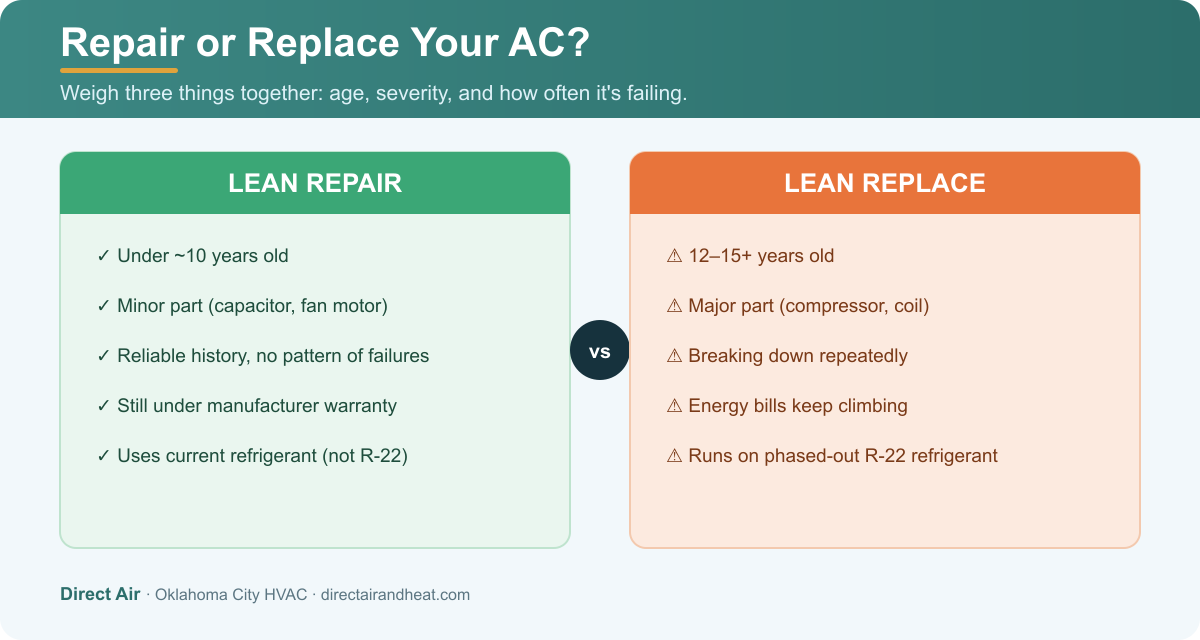
The better way to decide doesn't hinge on the repair quote alone. It hinges on three things together: how old the unit is, how major the failure is, and how often it's been breaking down. Get those three in view, and the answer is usually obvious.
The three questions that actually decide it
Before you think about the repair, run your system through these:
- 1How old is it? Most central ACs are built to last 15–20 years, but Oklahoma's long, brutal cooling season tends to wear them out closer to 12–17. Under about 10 years, repair is usually worth it. Past 12–15, the math shifts hard toward replacement.
- 2How major is the failure? A capacitor, contactor, or fan motor is a routine, minor fix. A compressor, evaporator coil, or condenser is a major one, and a major repair on an older unit is money poured into equipment that's near the end anyway.
- 3How often has it been failing? One repair on an otherwise reliable system is normal. A third service call in two summers is the system telling you it's done.
Lean repair, or lean replace?
Lean toward repair when the unit is under 10 years old, the failed part is a minor common component, it's been reliable, and it's still under manufacturer warranty.
Lean toward replacement when the unit is 12–15+ years old, the repair involves a major component, it's broken down repeatedly, and your energy bills keep climbing. In older Oklahoma homes, it still runs on R-22 refrigerant.
Why R-22 changes everything
If your AC was installed before about 2010, there's a good chance it uses R-22 (often called Freon). That refrigerant has been phased out of production, so any repair that requires recharging it is increasingly expensive and harder to source every year. On an older R-22 system, a refrigerant leak isn't really a repair decision. It's a strong signal to put that money toward a modern unit that uses current refrigerant and runs far more efficiently.
The Oklahoma factor most people underestimate
Two things about our climate tilt these decisions. First, the heat: a system here runs harder and longer than the same unit would in a milder state, so "12 years old" in Oklahoma is functionally older than 12 years elsewhere. Second, timing: ACs almost always fail on the hottest days because that's when they're working hardest, which is the worst possible time to be forced into a rushed decision. If your system is aging and limping, deciding before it dies in mid-July means you choose on your terms instead of in a crisis.
When it's an emergency, not a decision
If your AC has stopped cooling entirely during a heat wave and anyone in the home is vulnerable to the heat, that's a same-day repair situation. First, get the house safe, then make the repair-or-replace call with a clear head once the immediate problem is handled.
Direct Air is a family-owned Oklahoma City HVAC company, and we'll give you the honest version, including when a repair is the smart move and replacement would be overkill. We'd rather earn a replacement when it genuinely makes sense than sell you one you don't need. If you're weighing the decision, explore your options for AC replacement in Oklahoma City or have us diagnose the system first.
Proudly Serving Greater OKC
Need AC repair in Yukon or anywhere across the metro? Direct Air serves homeowners throughout Oklahoma City and the surrounding communities: Mustang, Edmond, Norman, Moore, Midwest City, Del City, Choctaw, Nichols Hills, Newcastle, Purcell, El Reno, and Weatherford, OK.
Frequently asked questions
Should I repair or replace my air conditioner? Weigh three things together: the unit's age, how major the repair is, and how often it's been failing. A newer system with a minor, one-time fix is worth repairing; an older system with a major or repeated failure usually points to replacement.
At what age should I replace my AC instead of repairing it? Under about 10 years, repair usually wins. Once a unit passes 12–15 years and Oklahoma's heat pushes systems toward the lower end of their lifespan, replacement typically becomes the better long-term decision.
Is it worth repairing an AC that uses R-22? Often not, especially for a refrigerant leak. R-22 has been phased out and is increasingly costly to source, so on an older R-22 unit that money is usually better invested in a modern, efficient replacement.
Why does my AC always break down on the hottest days? Because that's when it's working hardest. Extreme heat pushes a marginal system past its limit, which is exactly why an aging unit is best replaced before peak summer rather than during it.
How long do air conditioners last in Oklahoma? Typically 12–17 years here, within the broader 15–20 year range, because the long, hot cooling season adds wear. Regular maintenance helps a system reach the upper end.