How Long Does an AC Unit Last in Oklahoma's Heat?
Look this up and you will find the same answer everywhere: 15 to 20 years. That figure is a national average, and it quietly assumes a climate that is not ours. In Oklahoma, your air conditioner runs harder, longer, and hotter than the same unit would almost anywhere else, and the lifespan reflects it.
The realistic number here: 12 to 17 years, with well-maintained systems reaching the top of that range and neglected ones failing well below it. The gap between those two outcomes is not luck. It is almost entirely down to how the system was sized, installed, and cared for.
Why Oklahoma ages an air conditioner faster
Think of your AC's lifespan in run-hours, not calendar years. A system in a mild climate might cool for three months a year. Ours runs hard for five or more, including long stretches where it never fully shuts off because it is fighting 100°F afternoons. Every one of those hours is wear on the compressor, the fan motor, and the electrical components.
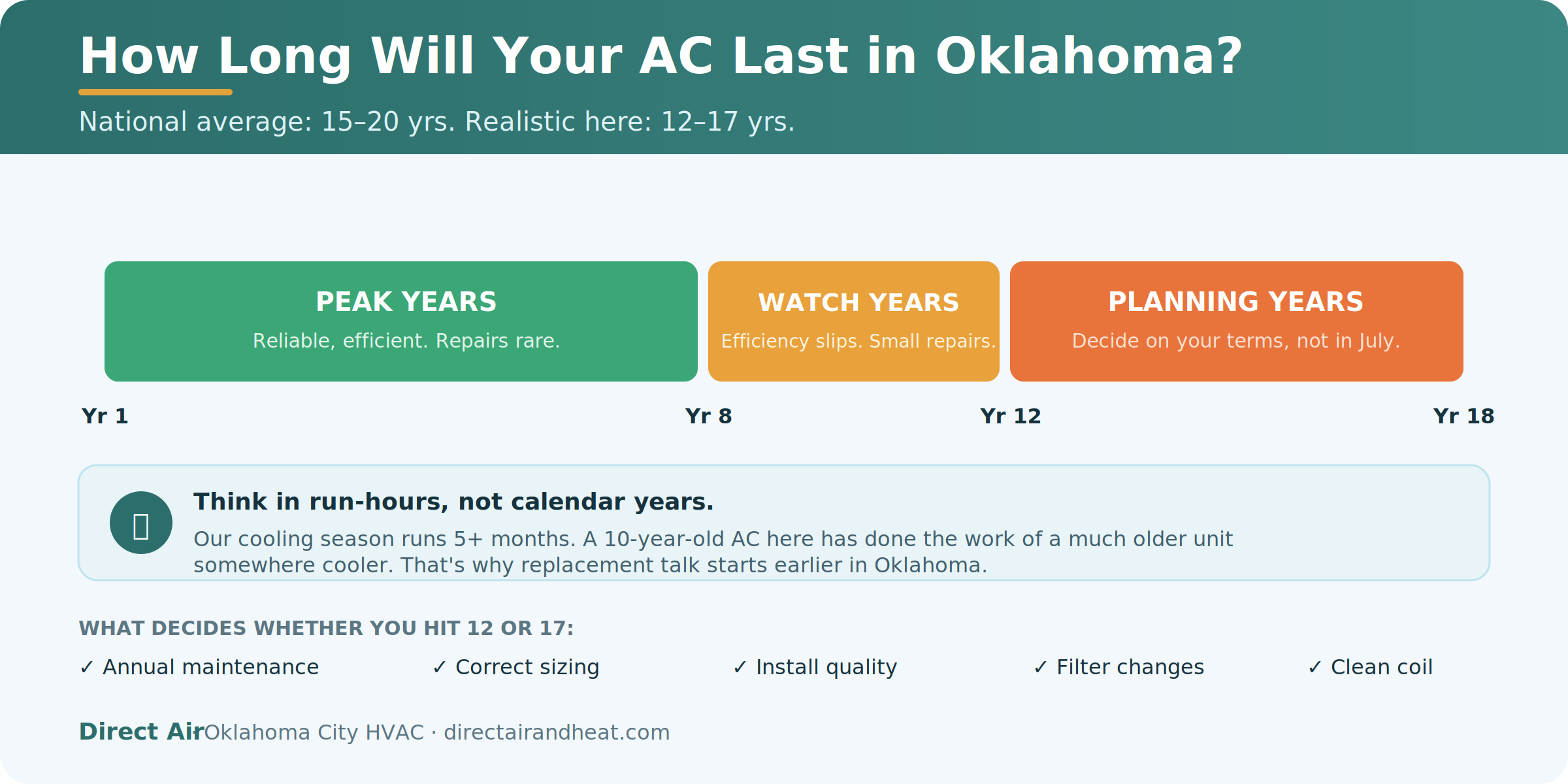
So a "10-year-old AC" in Oklahoma has often done the work of a considerably older unit somewhere cooler. That is the single most useful reframe in this whole topic, and it explains why replacement conversations start earlier here than the national averages suggest.
What actually decides whether yours lasts
Age is the outcome, not the cause. These are the causes:
- Maintenance. The biggest single factor, and the one entirely in your control. An annual tune-up keeps the coil clean, the refrigerant correct, and the airflow healthy, all of which reduce strain.
- Correct sizing. An oversized unit short-cycles, turning on and off constantly, and that repeated starting is what kills compressors early. A system that was oversized on day one was always going to die young.
- Installation quality. Poor airflow, bad ductwork, or an incorrect refrigerant charge from the start means the system spends its entire life working harder than it should.
- Filter changes. A clogged filter chokes airflow and forces longer run times. It is the cheapest thing on this list and the most commonly neglected.
- Outdoor conditions. Grass clippings, cottonwood, and dust caking the condenser coil mean the unit cannot dump heat and runs hotter.
Notice how many of these trace back to decisions made before the unit ever ran, which is why sizing and install quality matter so much.
The lifespan timeline
Roughly how to think about where your system is:
- Years 1 to 8, peak years. With maintenance, expect reliable performance and good efficiency. Repairs should be rare.
- Years 9 to 12, watch years. Efficiency starts slipping, small repairs appear. Maintenance matters more than ever here.
- Years 12 to 17, planning years. Repairs get more frequent and more expensive. This is where you want to be deciding on your own terms, not during a July breakdown.
Signs yours is near the end
- Repairs are becoming frequent or expensive
- Energy bills keep climbing despite maintenance
- It struggles to keep up during peak heat
- It uses phased-out R-22 refrigerant
- Some rooms never get comfortable anymore
The mistake worth avoiding
Waiting for total failure. An AC almost always dies on the hottest day of the year, because that is when it is working hardest, and that is the worst possible moment to be making a rushed, expensive decision with your house at 90 degrees inside. If your system is in the planning years and showing signs, deciding in advance means you choose the system, the timing, and the terms.
Direct Air is a family-owned Oklahoma City HVAC company, and we will tell you honestly whether your system has years left or is on borrowed time. If yours is in the planning years, let's talk before it decides for you. Explore air conditioner replacement in Oklahoma City.
Serving Homeowners Throughout the OKC Area
Direct Air replaces and maintains cooling systems for homes in Purcell, Newcastle, Norman, and across the metro: Oklahoma City, Edmond, Moore, Yukon, Mustang, Midwest City, Del City, Choctaw, Nichols Hills, El Reno, and Weatherford, OK.
Frequently asked questions
How long does an AC unit last in Oklahoma? Realistically 12 to 17 years here, below the 15 to 20 year national average, because our long, hot cooling season adds far more run-hours than milder climates. Maintenance is what gets you to the top of that range.
Why do air conditioners wear out faster in Oklahoma? Because lifespan is really about run-hours. Our cooling season stretches five or more months, with long periods where the system barely shuts off, so it accumulates wear much faster.
Can maintenance really extend my AC's lifespan? Yes, and it is the biggest factor in your control. Annual tune-ups and regular filter changes keep strain off the system and are the main difference between a unit that reaches 17 years and one that fails at 12.
At what age should I start planning to replace my AC? Once it passes about 12 years, especially if repairs are becoming frequent. Planning ahead means you decide on your terms rather than during a mid-summer breakdown.
Does an oversized AC fail sooner? Yes. Oversized units short-cycle, turning on and off repeatedly, and that repeated starting wears out the compressor years early.