
How Do I Improve the Indoor Air Quality in My Home?
Here is the uncomfortable fact behind this question: the air inside your home is often dirtier than the air outside it. Modern homes are built tight, which is great for energy bills and bad for air. Dust, pollen, pet dander, mold spores, cooking residue, and cleaning chemicals all get trapped inside and then recirculated through your HVAC system, over and over, all day.
In Oklahoma, that baseline problem gets amplified. We have long, aggressive pollen seasons and humid summers that encourage mold and dust mites. So "improve my indoor air" here is less about buying a gadget and more about fixing the conditions that let the pollutants thrive.
The four layers that actually work
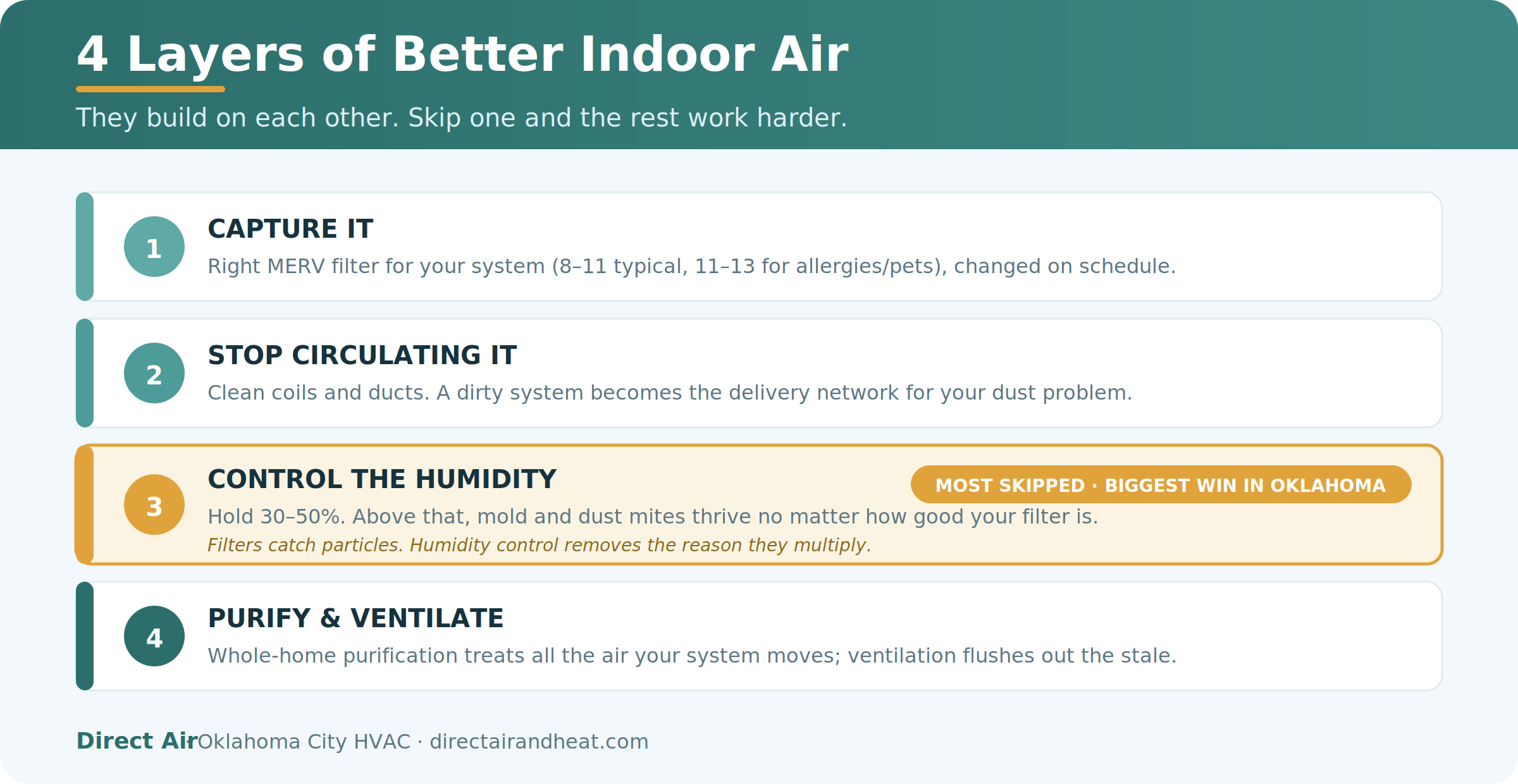
Most advice hands you a random list. It is more useful to think in layers, because they build on each other, and skipping the early ones makes the later ones far less effective:
- 1Capture it. Your air filter is the front line. Use an appropriate MERV rating your system can actually handle (8 to 11 for most homes, 11 to 13 if you have allergies or pets), and change it on schedule.
- 2Stop circulating it. A dirty system spreads what it collects. Clean coils, clean ducts, and regular maintenance keep your HVAC from becoming the distribution network for your dust problem.
- 3Control the humidity. This is the one people skip, and in Oklahoma it may matter most. Keep relative humidity between 30 and 50 percent. Above that, mold, mildew, and dust mites thrive no matter how good your filter is.
- 4Purify and ventilate. A whole-home air purifier treats the air throughout the house, and fresh-air ventilation flushes out what is stale.
Why humidity is the layer most people skip
You can install the best filter money can buy and still have poor air quality if your home sits at 60 percent humidity all summer. Here is why: dust mites and mold do not float in from outside so much as they grow in your home when conditions allow, and damp air is the condition they need. Filtration catches particles that are already airborne. Humidity control removes the reason they multiply in the first place. In an Oklahoma summer, that makes a dehumidifier one of the highest-impact air quality tools you can add, and it is why our humidity and air quality problems are really the same problem.
Do air purifiers actually work?
Yes, when matched to the problem, but with a caveat worth knowing. A portable purifier cleans one room. A whole-home purifier integrated into your HVAC system treats all the air your system circulates, which is why it does far more for whole-house air quality. Some use dense filtration to capture fine particles, others use UV light to neutralize mold and bacteria growing on the coil. The right choice depends on what you are actually fighting, so it is worth diagnosing before buying.
Your ducts might be the source
One overlooked culprit: if your ductwork leaks, it is pulling dust, insulation fibers, and attic debris into the system and blowing it into your living space. In that case, no filter upgrade fully solves the problem, because you are filtering air that keeps getting re-contaminated on the way to you. If your home is constantly dusty despite good filtration, get the ducts checked.
Quick wins you can do today
- Change your filter, every 30 to 60 days during heavy-use season.
- Vent moisture out: run bath and kitchen exhaust fans, and confirm the dryer vents outside.
- Set the AC fan to "Auto" rather than "On," so moisture drains off the coil instead of blowing back into the house.
- Keep the home clean and dry, since less dust and less damp means fewer allergens.
When to bring in help
If anyone in your home has allergies or asthma, if you have persistent dust or musty odors, or if standard filters are not keeping up, it is worth having someone assess the whole picture: filtration, humidity, ductwork, and ventilation together, rather than guessing at one piece.
Direct Air is a family-owned Oklahoma City HVAC company, and we would rather diagnose what is actually degrading your air than sell you equipment that treats the wrong layer. Learn more about whole-home air filtration in Oklahoma City.
Indoor Air Quality Services Across the Metro
Direct Air improves indoor air for homeowners in Newcastle, Norman, Oklahoma City, and throughout the surrounding area: Edmond, Moore, Yukon, Mustang, Midwest City, Del City, Choctaw, Nichols Hills, Purcell, El Reno, and Weatherford, OK.
Frequently asked questions
How can I improve indoor air quality in my home? Work in layers: use an appropriate MERV filter and change it on schedule, keep your HVAC system and ducts clean, hold humidity between 30 and 50 percent, and add whole-home purification or ventilation if needed.
What humidity level is best for indoor air quality? Between 30 and 50 percent. Above 60 percent, mold, mildew, and dust mites thrive, which no filter can fully offset.
Are whole-home air purifiers better than portable ones? For whole-house improvement, yes. They treat all the air your HVAC system circulates rather than a single room, so they address the entire home rather than one space.
Why is my house so dusty even with a good filter? Leaky ductwork is a common cause. Leaks pull dust, insulation fibers, and attic debris into the system and blow it through your home, re-contaminating the air after it has been filtered.
Does changing my air filter really improve air quality? Yes. The filter captures airborne particles as air circulates, and a clean, correctly rated filter is one of the most effective and affordable improvements you can make.